Home » Engagement & Wedding Rings » Diamonds
Your Guide to Marquise Cut Diamond Engagement Rings and Wedding Bands
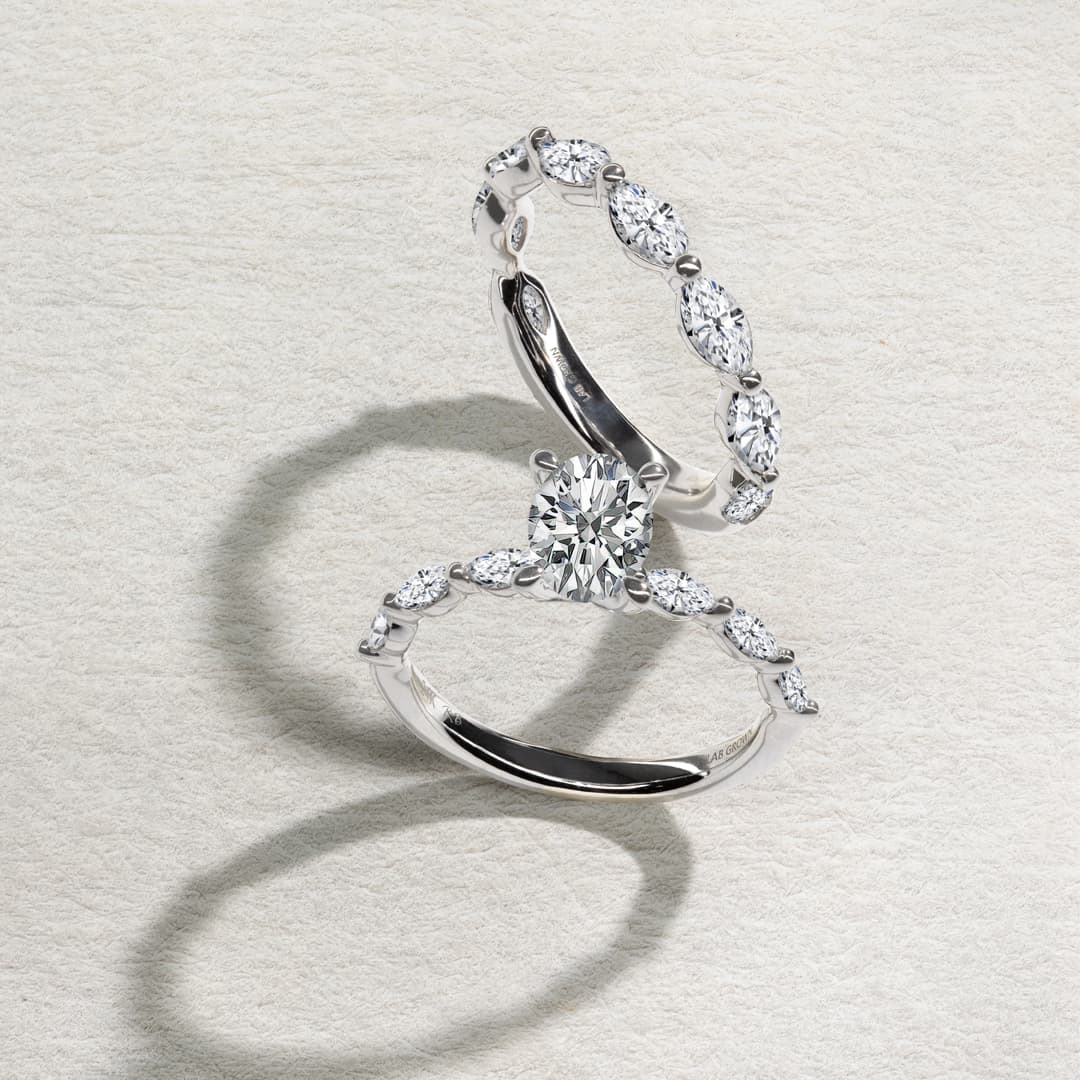


A marquise is an elongated brilliant cut with two pointed ends and softly curved sides, and it is one of the few shapes people recognize instantly. Choose it if you want something distinctive, or if you are drawn to a silhouette with genuine antique character. It carries light down a long outline rather than concentrating it in the middle, which is what gives the shape its particular drama on the hand.
This guide covers where the shape came from, what to look at before you choose one, and how a marquise behaves once there is a wedding band sitting next to it.
What Is a Marquise Cut Diamond
By long-standing account the shape is named for the Marquise de Pompadour of eighteenth-century France, its outline said to echo the line of her mouth. Gemological sources tell that story as legend rather than documented history, and it has followed the cut ever since either way. What is not in doubt is how the shape behaves: those long lines draw the eye down the finger, and because the stone spreads across the top rather than sinking into depth, a marquise tends to look larger than a rounder shape of similar weight.
If you are weighing the marquise against other elongated options, our guides to pear shaped diamonds and round brilliant diamonds are a useful comparison, since each handles the same problem of length and sparkle differently.
The two-tone solitaires here show the outline with nothing competing against it, in a range of weights, so the effect of size on the same design is easy to read.

14K Yellow Gold and 14K White Gold Marquise Solitaire Engagement Ring
- 14K yellow gold and 14K white gold two-tone shank, polished
- Marquise cut center stone in a solitaire setting
- 1 ct. tw.

14K Yellow Gold and 14K White Gold Marquise Solitaire Engagement Ring
- 14K yellow gold and 14K white gold two-tone shank, polished
- Marquise cut center stone in a solitaire setting
- 3/4 ct. tw.

14K Yellow Gold and 14K White Gold Marquise Solitaire Engagement Ring
- 14K yellow gold and 14K white gold two-tone shank, polished
- Marquise cut center stone in a solitaire setting
- 5/8 ct. tw.
Considerations When Choosing a Marquise Cut
A marquise rewards a little planning, and two details matter more than the rest. Both are far easier to judge in person than on a screen.
Length-to-width ratio
This describes how stretched the outline looks. A higher ratio reads long and dramatic; a lower one reads fuller and rounder. There is no correct answer, only the silhouette you like on your own hand, and the gap between ratios is obvious once two stones are side by side.
The bow-tie effect and protecting the points
Most elongated cuts show some shadow across the center, and a well-cut marquise keeps it faint enough to ignore. The pointed tips are the other consideration: they are the most vulnerable part of the stone, so we recommend a V-shaped prong at each end to guard them. If you would rather choose the stone first and build around it, start with our loose diamonds and design the setting to suit it.
Lab-grown stones make the larger end of the range reachable, and the group here runs across a wide spread of weights in the same white gold setting so the jump in scale is easy to see.

Eternalle 14K White Gold Lab-Grown Diamond Engagement Ring
- 14K white gold from Eternalle, 2.2 mm shank, rhodium plated
- Marquise cut lab-grown center stone, prong set
- 4 ct. tw. total, VS2 clarity and G color minimums

Eternalle 14K White Gold Lab-Grown Diamond Engagement Ring
- 14K white gold from Eternalle, 2.1 mm shank, rhodium plated
- Marquise cut lab-grown center stone, prong set
- 3 1/4 ct. tw. total, VS1 clarity and F color minimums

Eternalle 14K White Gold Lab-Grown Diamond Engagement Ring
- 14K white gold from Eternalle, 2.2 mm shank, rhodium plated
- Marquise cut lab-grown center stone, prong set
- 2 1/4 ct. tw. total, VS1 clarity and F color minimums
What to Weigh on a Marquise
01
LENGTH TO WIDTH
A long ratio reads dramatic, a shorter one reads full and soft. This is personal, and it is the first thing to compare in person.
02
THE BOW-TIE
A shadow across the center that moves as the ring moves. A good cut keeps it faint, and no photograph will show you how faint.
03
THE POINTS
The tips are the thinnest part of the stone. A V-shaped prong at each end takes the knock so the diamond does not.
Marquise Cut Diamonds in Wedding Bands
The marquise is not only a center-stone shape. Set end to end, or alternated with round diamonds, small marquises bring the same elongating line to a wedding band, and they sit naturally against a matching engagement ring. If a marquise center feels bold for everyday wear, a marquise-accented band is a gentler way to carry the shape.
There is a fit question underneath this that only shows up in person. A marquise center comes to a point at both ends, so how flush a band sits against it depends on where those points fall and how low the setting rides. When you are ready to see the two together, book an appointment and we will match them on your hand.
The Robbins Brothers Difference
A marquise is a shape you have to see moving. The bow-tie appears and disappears as the ring turns, the ratio reads differently on a long finger than a short one, and neither of those things survives a photograph. We keep a range on hand precisely so the comparison can be made side by side, and our diamond experts will talk you through what you are looking at rather than around it.
Frequently Asked Questions
Frequently Asked Questions
What is a marquise cut diamond?
It is an elongated, modified brilliant cut with two pointed ends and gently curved sides. The shape has a vintage, regal character and stands out from more common cuts. Stop by any of our showrooms across California, Arizona, Texas, and Washington to see one sparkle in person.
Does a marquise cut look bigger for its carat weight?
Usually, though how much depends on the individual stone. A marquise spreads its weight across a long top rather than down into the depth, so more of the stone faces up at you. Ask for the millimeter measurements alongside the carat weight, because that is the pair of numbers that tells you what will actually show on your hand.
What is the bow-tie effect?
It is a shadow that can fall across the middle of an elongated cut, where the facets fail to bounce light back at you. Almost every marquise has one to some degree, and the question is whether you notice it. It moves as the ring moves, which is why a photograph is a poor way to judge it and a few minutes under our showroom lights is a good one.
What settings best protect a marquise diamond’s points?
The two tips are the thinnest part of the stone and the part most likely to chip. A V-shaped prong at each end cups the point and takes the knock before the diamond does. Plain round prongs can work, but they need to sit right at the tip rather than back along the curve.
How does a marquise compare with a pear or oval?
All three stretch the finger, and the difference is in the ends. A marquise comes to a point at both, a pear at one, and an oval at neither. That changes what you have to protect and how the ring sits under a wedding band. Our guides to pear shaped diamonds and cushion cut diamonds go further into each.
Should I choose a natural or lab-grown marquise diamond?
Both are real diamonds with the same brilliance, and the difference is origin. A lab-grown stone generally lets you reach a larger marquise, or a cleaner one, for the same outlay. We carry both and will put them next to each other so the trade-off is something you can see rather than take on trust.
Can I design a custom marquise ring?
Yes. Our master jeweler can build a one-of-a-kind marquise engagement ring, or a band to sit against one, around a loose stone you have chosen. Bring what you have in mind to an appointment and we will draw it out with you.
Do I need an appointment or can I walk in?
Walk-ins are always welcome. Booking ahead means a diamond expert is set aside for you and marquise options are waiting when you arrive, which is worth doing if you want to compare several side by side.
For more inspiration:
Ready to see marquise diamonds in person? Find a Robbins Brothers near you and let our experts help you find the one. You can also browse our Pinterest board for inspiration.
Recommended
What’s an Old Mine Elongated Cushion Cut Diamond and a Bezel Engagement Ring Setting? All the Details about Taylor Swift’s Fantastic Engagement Ring
We’ve all seen the proposal and the ring (and the fan edits and the podcast and the…). But exactly what…
read more
The Vintage Baguette Cut Diamond: A Buying Guide
If you love clean lines, geometric shapes, and jewelry that makes a statement through subtlety rather than sheer sparkle, the…
read more
The Timelessness and Uniqueness of Natural Diamonds
When you are shopping for an engagement ring, wedding band, or other jewelry, you can choose lab-grown or natural diamonds….
read more