Home » Engagement & Wedding Rings » Engagement Rings
Elegance in Simplicity: A Guide to Minimalist Engagement Rings, Wedding Bands, and Fine Jewelry


The appeal of minimalist jewelry is that it does not ask for your attention. Clean lines, narrow proportions, careful finishing, and nothing on the piece that is not doing a job. Done well it reads as calm rather than plain, because the materials are carrying it instead of the decoration.
Low profile is the other half of the idea and the practical half. A setting that sits close to the finger catches on far less as you move through a day, which is why people who never take their rings off tend to end up there. Everything below is grouped that way: settings with narrow shanks, wide bands in plain metal, ring and band pairings, and the fine jewelry that finishes the look.
How to Build a Minimalist Look
01
KEEP THE SHANK NARROW
Width decides whether a ring reads delicate or substantial, and it does more for that than the stone does. The settings here sit between 1.6 and 1.8 mm across, which is where the look lives.
02
LET ONE THING BE THE FOCUS
A minimalist piece has a single point of interest: one stone, one line, one broad plane of metal. Two details competing for the eye is the point at which the whole effect stops working.
03
KEEP THE METAL CONTINUOUS
Rings, ears and neck in the same metal read as a collection that was chosen. Mixed by accident, they read as pieces that arrived separately, which is the opposite of the effect you are after.
Thin-Band Engagement Ring Settings
A narrow shank does two things at once. It leaves the center stone looking larger by comparison, and it keeps the ring light on the hand. These are all settings, sold without a center stone, so the diamond is a separate decision and the shape is yours. A round or cushion cut in a bezel setting is the cleanest version of this, though each of these is cut for a particular shape.

A.Jaffe 14k Yellow Gold Natural Diamond Engagement Ring Setting .07 ct. tw.
- A 1.8 mm shank in 14k yellow gold, about as narrow as a setting goes
- Cut to take a round center stone, which is not included
- .07 ct. tw. of accent diamonds from A.JAFFE

Tacori 18k Yellow Gold and 18k White Gold Natural Diamond Engagement Ring Setting 1/8 ct. tw.
- The narrowest here at 1.6 mm, in two-tone 18k yellow and white gold
- Shaped for a radiant center stone, sold separately
- 1/8 ct. tw. of accent diamonds, finished with Tacori milgrain

Tacori 18k Yellow Gold Natural Diamond Engagement Ring Setting 1/3 ct. tw.
- An 18k yellow gold shank at 1.8 mm with milgrain along the edge
- Shaped for a pear center stone, sold separately
- 1/3 ct. tw. of accent diamonds, the heaviest accent weight here
Wide-Band Wedding Rings
A wide band is the other minimalist answer, and the opposite move: no stones at all, just a width, a shape and a finish. Below is the same Mfit design in white gold, yellow gold and platinum, each with a satin face, polished stepped edges, and a scalloped comfort-fit interior. There is more in our women’s wedding bands and our men’s wedding bands, and our guide to wide wedding bands covers how width actually wears.

Mfit 14k White Gold 8 mm Wedding Band
- 8 mm of 14k white gold, satin across the face with polished edges
- Rhodium plated, so the white stays cool rather than warm
- 1.7 mm through the finger, the slimmest of these

Mfit 14k Yellow Gold 8 mm Wedding Band
- The same 8 mm profile in warm 14k yellow gold
- Satin face, polished stepped edges, no stones anywhere on it
- 2 mm through the finger, so it feels the most substantial

Mfit Platinum 7 mm Wedding Band
- Platinum at 7 mm, the narrowest of these but the densest metal
- The same satin face and stepped edge as the gold pair
- 1.8 mm through the finger, with a scalloped comfort-fit inside
Engagement Ring and Wedding Band Pairings
Continuity is what makes a ring and a band read as a pair rather than as two separate purchases. Match the metal first and the scale second: a narrow engagement shank wants a narrow band beside it, or the band ends up doing all the talking. If you would rather see how a pairing actually sits before deciding, book an appointment and we will put them on the same finger. Our guides to platinum and white gold are worth a look if you are deciding between them.

A.Jaffe 18k Yellow Gold and Platinum Head Natural Diamond Engagement Ring Setting 1/2 ct. tw.
- An 18k yellow gold shank with a platinum head, so the setting reads white against warm gold
- A three-stone layout: a round center accommodation flanked by side stones
- 1/2 ct. tw. of accent diamonds, center stone not included

A.Jaffe 14k Yellow Gold Natural Diamond Wedding Band 5/8 ct. tw.
- Round and marquise diamonds alternating along the shank
- 5/8 ct. tw. of natural diamonds in 14k yellow gold
- A 1.9 mm width, cut to sit flush against a narrow engagement ring

Memoire Platinum Natural Diamond Wedding Band 1/4 ct. tw.
- A platinum band, pave set across the top by Memoire
- 1/4 ct. tw. of natural diamonds
- 1.3 mm through the finger, the lowest profile in this guide
Minimalist Earrings, Necklaces, and Bracelets
The same discipline carries well past rings, but the canvas changes. An ear, a collarbone and a wrist each show a piece differently, and each of them forgives decoration less readily than a hand does. Our earrings, necklaces and pendants and bracelets have plenty more in this register.

14k White Gold Solitaire Natural Diamond Stud Earrings 1 1/2 ct. tw.
- A single solitaire stone in each ear, 1 1/2 ct. tw. across the pair
- Rhodium-plated 14k white gold
- Friction backs, the simplest fitting there is

14k White Gold Solitaire Natural Diamond Pendant 3/4 ct. tw.
- One 3/4 ct. natural diamond held in a three-prong setting
- A fine cable chain at 16 inches with a 2 inch extender
- Nothing else on the chain, which is rather the point

Eternalle 14k White Gold Lab-Grown Diamond Bracelet 5 ct. tw.
- A continuous line of Eternalle lab-grown diamonds, 5 ct. tw.
- 7.5 inches of 14k white gold on a push-lock clasp
- Uniform stones the whole way round, with no focal point
The Robbins Brothers Difference
We have been helping people choose fine jewelry since 1921, and simple pieces are the least forgiving things we sell. With no decoration to distract the eye, everything shows: the evenness of a shank, the seat of a stone, the line where a satin finish meets a polished edge. Only about one diamond in ten meets our standard, and on a solitaire that one diamond is the entire piece.
Our master jeweler works in house, so a shank can be narrowed, a setting lowered, or two rings fitted to sit flush against each other without anything leaving the building. Every piece carries our best-in-class lifetime warranty, with complimentary cleaning and inspection at any of our showrooms, which matters more on plain metal than most people expect: a satin finish picks up the marks of a year quietly, and we can bring it back.
Frequently Asked Questions
What defines minimalist jewelry?
Clean lines, restrained detail, and proportions kept deliberately narrow, so the metal and the stones carry the piece rather than the ornament around them. In practice that means thin shanks, bezel and low settings, solitaire studs and fine chains. It is a discipline about what to leave out, which is why a plain piece is often harder to make well than a busy one.
Are thin bands durable enough for everyday wear?
Yes, with the caveat that metal choice does most of the work. Platinum is the most forgiving because it displaces rather than loses material when it is knocked, so a narrow platinum shank wears down more slowly than a narrow gold one. If you work with your hands, tell us and we will steer you on both the metal and the width.
What is the difference between a low-profile and a high setting?
A low-profile setting holds the center stone close to the finger, so it snags less on clothing and sits flatter under a glove. A high setting lifts the stone away from the hand, which lets more light in underneath and makes it look larger. For a minimalist look we usually point people lower, but it is worth trying both on, because the difference is far more obvious on a hand than in a photograph.
Which metals suit a delicate, minimalist look?
Platinum and white gold both give a cool, seamless finish that keeps the attention on the diamond, and platinum has the density to hold a narrow shank straight. Yellow gold does something different: it puts warmth into a plain silhouette, which is why every setting in the first section here is yellow. There is no wrong answer, only a decision to make once and then repeat across your other pieces.
Can I stack minimalist bands?
Thin bands are close to purpose-built for it, because the whole stack still reads as slim. The two things to watch are that the widths differ enough to be visible as separate rings, and that only one of them carries the detail. Bring in what you already own and we will build around it rather than starting from nothing.
Do minimalist settings work with any diamond shape?
They do, and the settings on this page are cut for three different ones: round, radiant and pear. A plain shank frames a shape rather than competing with it, which is why elongated cuts in particular tend to look their best in a simple setting. Come and compare a few on your own hand, because shape reads very differently on different fingers.
Can you create a custom minimalist design?
Yes, and simple work is some of the most satisfying our master jeweler does, because there is nowhere for a shortcut to hide. A bespoke narrow shank, a bezel cut to a stone you already own, a pendant made from an inherited diamond. Custom work needs lead time, so start the conversation earlier than you think you need to.
Do I need an appointment, or can I walk in?
Walk-ins are always welcome. Booking does mean a consultant is free the moment you arrive, which helps if you want to compare several narrow settings side by side under the same light. You are welcome at any of our showrooms across California, Arizona, Texas and Washington.
Or find a Robbins Brothers near you and let our experts help you put the look together in person.
Recommended
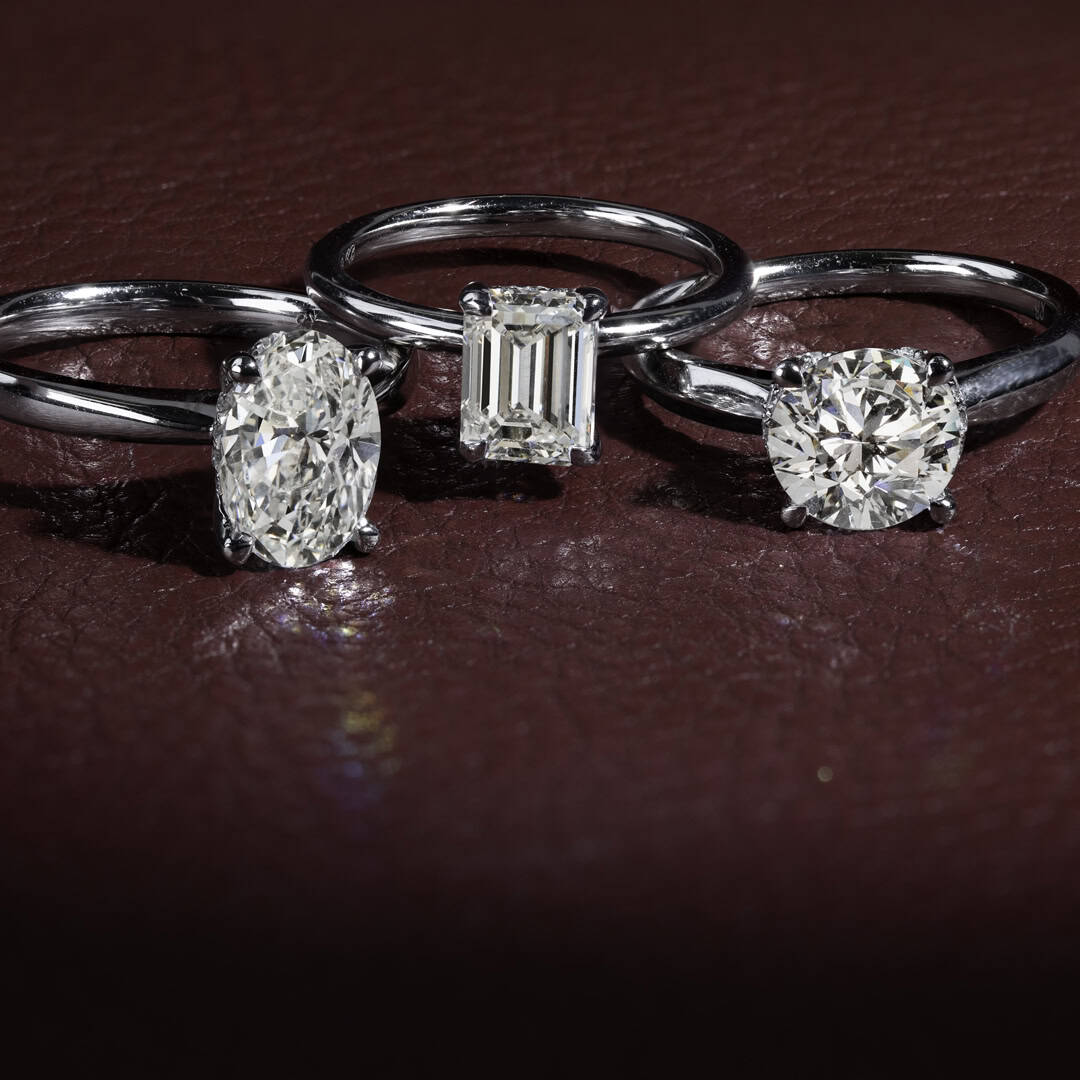
Questions to Ask When Shopping for An Engagement Ring
Ask as many questions as you need to when shopping for an engagement ring. We are here to help you feel confident and knowledgeable as you choose your perfect ring.
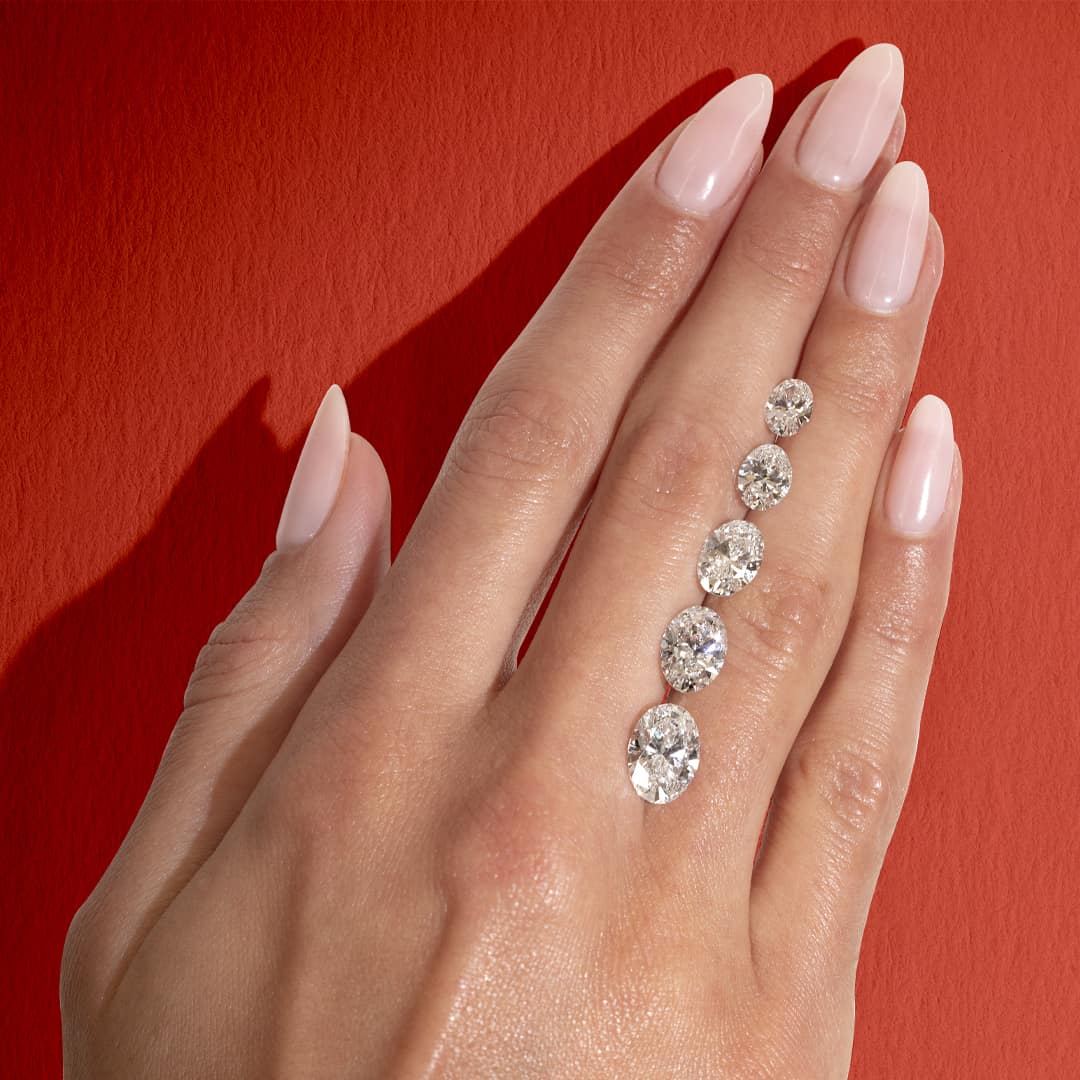
All About Oval Diamond Engagement Rings
Oval diamond engagement rings pair the fire of a round brilliant with a longer, softer outline, and the shape has…
read more
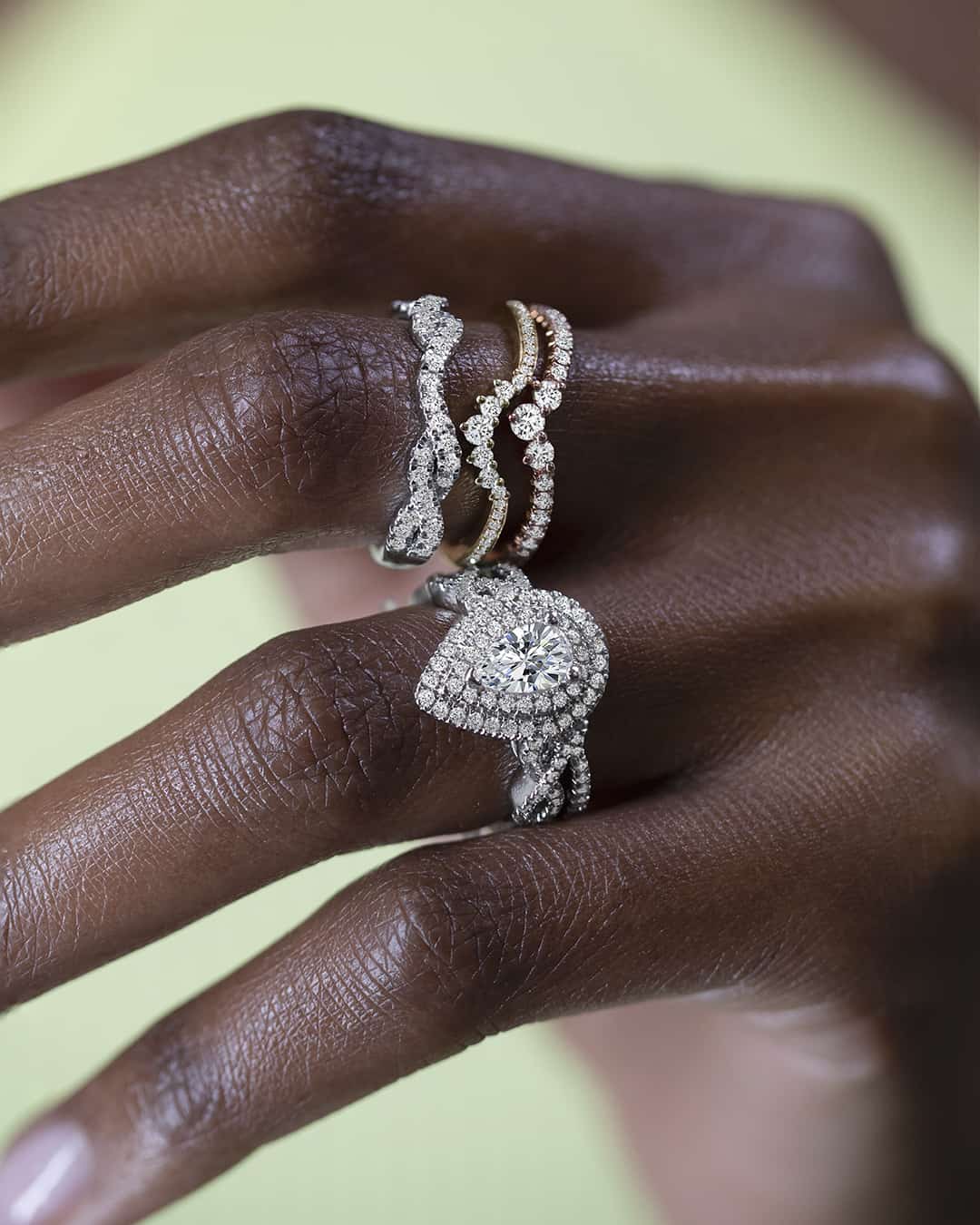
Pavé Diamond Band Engagement Rings, Wedding Rings, and Jewelry
A pave setting places small stones low in the metal and close together, so the surface reads as a near-continuous…
read more