Mixing Metals in Bracelet and Necklace Layered Stacks
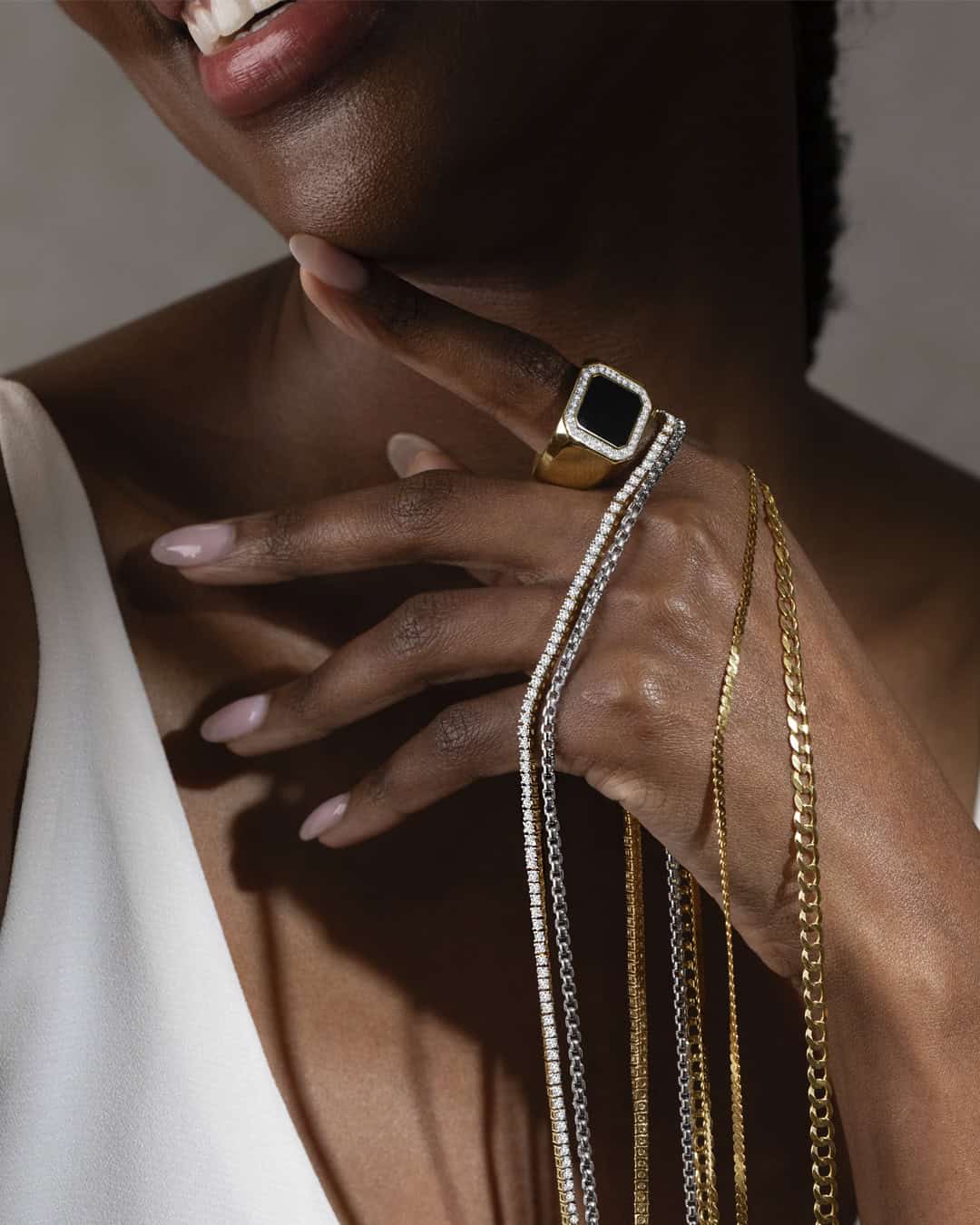


There can be a misconception that mixing metal tones should be avoided. Walk through any of our showrooms today and the stacks our guests are building are deliberately two- and three-metal: yellow gold warming up a white gold tennis bracelet, a platinum band sitting between two 18K pieces, a rose gold chain layered under a yellow one. Mixing metals adds interest, uniqueness, and intentional style.
Layered bracelet and necklace stacks are the easiest place to start, because you can add one piece at a time and rearrange them endlessly. Below is how we build them: which pieces do the work of holding a mixed stack together, how to space and scale them, and the specific combinations our guests keep coming back for.
Three Things That Make a Mixed Stack Work
01
LET DIAMONDS BRIDGE
Diamonds read as neutral against every metal. A diamond bracelet or a diamond-set pendant sitting in the middle of a stack gives the eye a resting point and makes the metal change look intentional rather than accidental.
02
VARY THE SCALE
Stacks fail when every piece is the same width. Put two or three slim pieces against one wider or bolder one. The contrast in proportion does as much work as the contrast in color.
03
REPEAT EACH METAL
A single odd piece looks like a mistake. The same metal appearing twice in a stack, or echoed on the other wrist, at the neck, or on a hand, reads as a decision.
Where the Old Rule Came From
The instruction to keep metals separate was never a design principle. It came from a period when a jewelry wardrobe was small and matched, and when most people owned one good set rather than a collection built over years. Matching was a way of making a few pieces look deliberate.
What changed is how people buy. A stack accumulates: a graduation gift in yellow gold, a self-purchase in platinum, an inherited piece in something else entirely. Insisting those match would mean not wearing most of them, which is the opposite of what a collection is for.
Bracelet and Bangle Stacks
The wrist is where we usually tell guests to begin. You see your own bracelets all day, so you learn quickly which combinations you actually reach for, and building it up gradually is far less daunting than rebuilding a whole look at once. It is also the easiest place to prove the point about diamonds: put a diamond bracelet between an 18K yellow gold piece and an 18K white gold one and the mix stops looking like a mix at all.

Memoire 18k White Gold Natural Diamond Bracelet 1 ct. tw.
- A slim 18k white gold bangle with a curved pave bar across the front
- 1 ct. tw. of natural diamonds, the heaviest weight here
- Rhodium plated, and it sits flat against whatever is beside it

Memoire 18k Yellow Gold Natural Diamond Bracelet 1/2 ct. tw.
- A hinged 18k yellow gold bangle with openwork through the band
- Bezel-set natural diamonds scattered across the face, 1/2 ct. tw.
- The widest piece here, so it anchors the scale of a stack

Memoire Platinum Natural Diamond Wedding Band 1/2 ct. tw.
- Platinum, pave set across a 2.3 mm top
- 1/2 ct. tw. of natural diamonds
- A band rather than a bracelet, and the third metal in the mix
Mix Widths, Not Just Metals
Identical widths in different metals tend to read as indecision. The fix is proportion. Anchor the stack with something substantial, such as a wide diamond tennis bracelet, then layer slimmer pieces beside it. Texture pulls its weight here too: a matte stone or a polished link beside brilliant-cut diamonds gives the eye somewhere else to go. Our guide to wearing tennis bracelets and necklaces goes deeper on placing the anchor piece.

Lab-Grown Diamond and Onyx Layers
- Skus: 0454479
- Eternalle 14K white gold lab-grown diamond bracelets, 2 1/4 ct. tw. and 6 ct. tw.
- Jaibor Uomo 14K yellow gold onyx bracelet for warmth and matte contrast
- Pairs high-sparkle white metal against warm gold and black stone
Build Around a Bangle
Bangles are the most forgiving pieces in a mixed stack because they hold their own shape. They sit apart from each other instead of tangling, so each metal stays legible. We like a slim yellow gold bangle, a broader white gold piece, and an open platinum cuff that introduces a third metal without adding bulk. If you are new to bangles, our guide to choosing and styling bangle bracelets covers fit and sizing first.

14k Yellow Gold and Titanium Natural Diamond Bangle Bracelet
- 14K yellow gold and titanium
- Natural diamonds, 1/2 ct. tw.
- Slim profile that sits flat against other bangles

14k White Gold and Titanium Natural Diamond Bangle Bracelet
- 14K white gold and titanium
- Natural diamonds, 5/8 ct. tw.
- Wider diamond face to anchor the stack

Platinum Born Mini Limitless Cuff Bracelet
- Platinum
- Platinum Born designer collection
- Open cuff adds a third metal and slides on easily
Chain Bracelets Layer Like Necklaces
Chain bracelets follow the same logic as layered chains at the neck: change the link, not just the length. A rope, a round box and a flat curb in the same 14K yellow gold still read as distinct pieces, because each link catches light differently. Add one in white or rose gold and the stack gains a second dimension. Beaded bracelets slot into this kind of stack easily too, and bring in color; our post on the latest beaded bracelet trend covers how to build one.

14k Yellow Gold 8″ Rope Chain Bracelet
- A silk rope link at 3.7 mm, twisted so it catches light along its length
- 8 inches, and the shortest bracelet in this run
- The softest texture of these against the wrist

14k Yellow Gold 8.25″ Box Like Chain Bracelet
- A round box link, squared in profile rather than flat
- 8.25 inches, polished to a high shine
- The most architectural of these, and the one that reads widest

14k Yellow Gold 8.5″ Curb Chain Bracelet
- A flat curb link at 4.7 mm that lies close to the skin
- 8.5 inches, the longest here, on a lobster claw clasp
- The quietest of these, which makes it the easiest to layer under
Stack white gold, yellow gold, and rose gold bracelets together, or combine several thin bangles with a wide one. Browse our bracelets, bangles, beaded bracelets, and tennis bracelets, or start from the full fine jewelry collection.
Layered Necklaces
Necklaces need one thing bracelets do not: deliberate spacing. Roughly two inches between each layer keeps the chains from overlapping and hiding each other, which is what makes a layered look read as styled instead of tangled. A workable starting set is a 16 to 18 inch chain sitting near the collarbone, something in the low twenties, and a 24-inch that falls below both. Once the spacing is right the metals can do whatever you want. Check which piece is shortest before you buy: a diamond necklace worn high sits above the run and draws the eye up, which is a different look from hanging one at the bottom.

Eternalle 14k Yellow Gold Lab-Grown Diamond Necklace 4 ct. tw.
- A continuous tennis line of Eternalle lab-grown diamonds, 4 ct. tw.
- 16.5 inches with a 2 inch extender, so it sits highest in the run
- 14k yellow gold on a push-lock clasp

14k Yellow Gold 18″ Serpentine Chain Necklace
- A 2 mm serpentine link, flat and smooth against the skin
- 18 inches in polished 14k yellow gold
- The middle length here, and the plainest of the run

14k White Gold 24″ Box Chain Necklace
- A 2.5 mm round box link in rhodium-plated 14k white gold
- 24 inches, the longest here, so it falls below the others
- The only white metal in this run, which is what makes it a mix
You can layer chains, pendants, or pearls in the same run. For a bolder version of this, several heavy chains worn together create a striking maximalist look; for the fundamentals of proportion and neckline, start with our guide to layering necklaces.
Add Color at Different Lengths
Pendants are where a mixed-metal stack gets personal. Hanging colored gemstones at different lengths means each stone sits in its own space rather than competing, and the settings give you a second way to mix metal: a yellow gold pendant above two white gold ones keeps the warm tone in play without repeating the chain. Birthstones, anniversary stones, or simply the colors you like most all work on the same principle.

Shy Creation 14k Yellow Gold Mother of Pearl Natural Diamond Necklace
- 14K yellow gold
- Shy Creation designer collection
- Mother of pearl with natural diamonds, .02 ct. tw.

14k White Gold Genuine Emerald and Natural Diamond Pendant
- 14K white gold
- Genuine emerald centered in natural diamonds
- Natural diamonds, 1/10 ct. tw.

14k White Gold Genuine Blue Sapphire and Natural Diamond Pendant
- 14K white gold
- Genuine blue sapphire centered in natural diamonds
- Natural diamonds, 1/10 ct. tw.
Browse our necklaces, tennis necklaces, and colored gemstone pendants.
Mixed Ring Stacks
Rings are where guests hesitate most, because an engagement ring is usually already set in a metal that feels non-negotiable. It is not. Choosing wedding bands in a different metal than the center ring frames it rather than blending into it, and it frees the rest of your jewelry: a yellow gold engagement ring stops dictating that every other piece you own must be yellow gold. Bands set with colored gemstones or birthstones add the same personal layer that pendants do at the neck, and our women’s wedding bands come in every metal we carry. Our guide to creating the perfect wedding ring stack walks through the order pieces should sit in.

RB Signature 14k Yellow Gold Natural Diamond Engagement Ring Setting 1/4 ct. tw.
- A 1.6 mm yellow gold shank, cut to take a radiant center stone
- 1/4 ct. tw. of accent diamonds; the center stone is not included
- RB Signature, and the piece the rest of the stack is built around

14k Yellow Gold 1.5 mm Fashion Ring
- A plain 1.5 mm band with a milgrain edge and no stones at all
- 14k yellow gold, the narrowest ring here
- Sits flush beside a setting without competing with it

14k Yellow Gold Ruby and Natural Diamond Fashion Ring 1/8 ct. tw.
- Clusters of rubies alternating with natural diamonds along the top
- 1/8 ct. tw. of diamonds in 14k yellow gold, on a 1.9 mm shank
- The only color in the stack, which is why it works beside plain bands
Caring for a Mixed-Metal Stack
Stacking means your pieces spend all day touching each other, and metals wear differently. The higher the karat, the softer the gold, so an 18K bangle picks up fine surface marks sooner than a 14K one, particularly where a wider piece rubs against a slim one. Platinum marks too, but the metal displaces rather than wearing away, which is why platinum pieces tend to develop a soft patina instead of thinning. None of that is damage, and our master jeweler can polish or refinish any of it.
- Store pieces separately, in a divided box or individual pouches, so they are not scratching each other overnight as well as all day.
- Take stacks off before anything abrasive: the gym, gardening, cleaning, the pool.
- Clean with warm water, mild dish soap, and a soft brush, then dry fully. Skip ultrasonic cleaners on pieces with pearls, onyx, emeralds, or other porous or included stones.
- Have clasps, links, and stone settings checked once a year, because layered pieces catch on clothing far more than a single chain does.
The Robbins Brothers Difference
We have been helping people choose jewelry for more than a hundred years, and building a stack is exactly the kind of thing that is easier with someone beside you. In our showrooms you can lay pieces on your own wrist and see how 18K yellow reads against platinum in real light, which is something no product photo settles for you. Our jewelry consultants will pull pieces across metals and price points without pushing you toward a complete set, because most of the best stacks we see were built one piece at a time.
“The stacking and layering trend is so popular because it is a form of self-expression. I’m single, but I have a bracelet stack. Let’s say I got a promotion, for example, I’m going to add another bracelet to my stack. It symbolizes something for me,” our Marketing Director Tracey Lyles told Pasadena Weekly. That is the part we like most: a stack is never finished.
Frequently Asked Questions
Can you really mix yellow gold with white gold and platinum?
Yes. The old rule against it was a convention, not a design principle, and it has largely fallen away. What makes a mix work is structure: repeat each metal at least twice, vary the widths, and give the eye a neutral resting point such as a diamond piece. What makes it look accidental is a single stray piece in a metal that appears nowhere else.
How many bracelets should be in a stack?
Three to five is the range most people settle at. Odd numbers tend to look more natural than even ones, and past five you generally want at least one wide piece so the stack has a clear anchor instead of reading as uniform clutter. Start with three and add over time.
What necklace lengths layer best together?
Leave about two inches between layers so no chain hides the one above it. An 18-inch, a 22-inch and a 24-inch is a reliable starting set, and you can push the longest piece further down once you know how the run sits on you.
Will mixing metals damage my jewelry?
Stacking causes surface wear rather than damage, and it is worth knowing that the wear is not even: the piece that moves most, usually the widest one, takes the marks for the whole stack. Bring it in and we will refinish it.
Can I mix metals with my engagement ring and wedding band?
You can, and many of our guests do deliberately. A band in a contrasting metal outlines the center ring rather than disappearing beside it. If the two rings sit together and rub constantly, matching the karat helps them wear at a similar rate, so bring both in and we will check the fit.
Where do I start if I own almost no jewelry yet?
One chain bracelet and one diamond piece. The chain establishes a metal, the diamond gives you the neutral that lets you add a second metal later without the stack looking like an accident.
Find a Robbins Brothers near you to try stacks on and see how the metals work together in person or browse our Pinterest board for inspiration.
Recommended
Layering Necklaces for That Perfect Style
Layering necklaces is one of the easiest ways to make an outfit feel finished, whether you are dressing up a…
read more
Our Complete Guide to Jewelry Chain Types
Every jewelry chain is a row of metal links, and the shape of those links is what gives a cable…
read more
Maximalist Jewelry Trends: Bold and Colorful Earrings, Necklaces, and More
If you are loving the maximalist jewelry trend as much as we are, this post is for you. Maximalist jewelry…
read more