Home » Engagement & Wedding Rings » Tips and Advice
You Got a Proposal Without A Ring: What Should You Do Next?
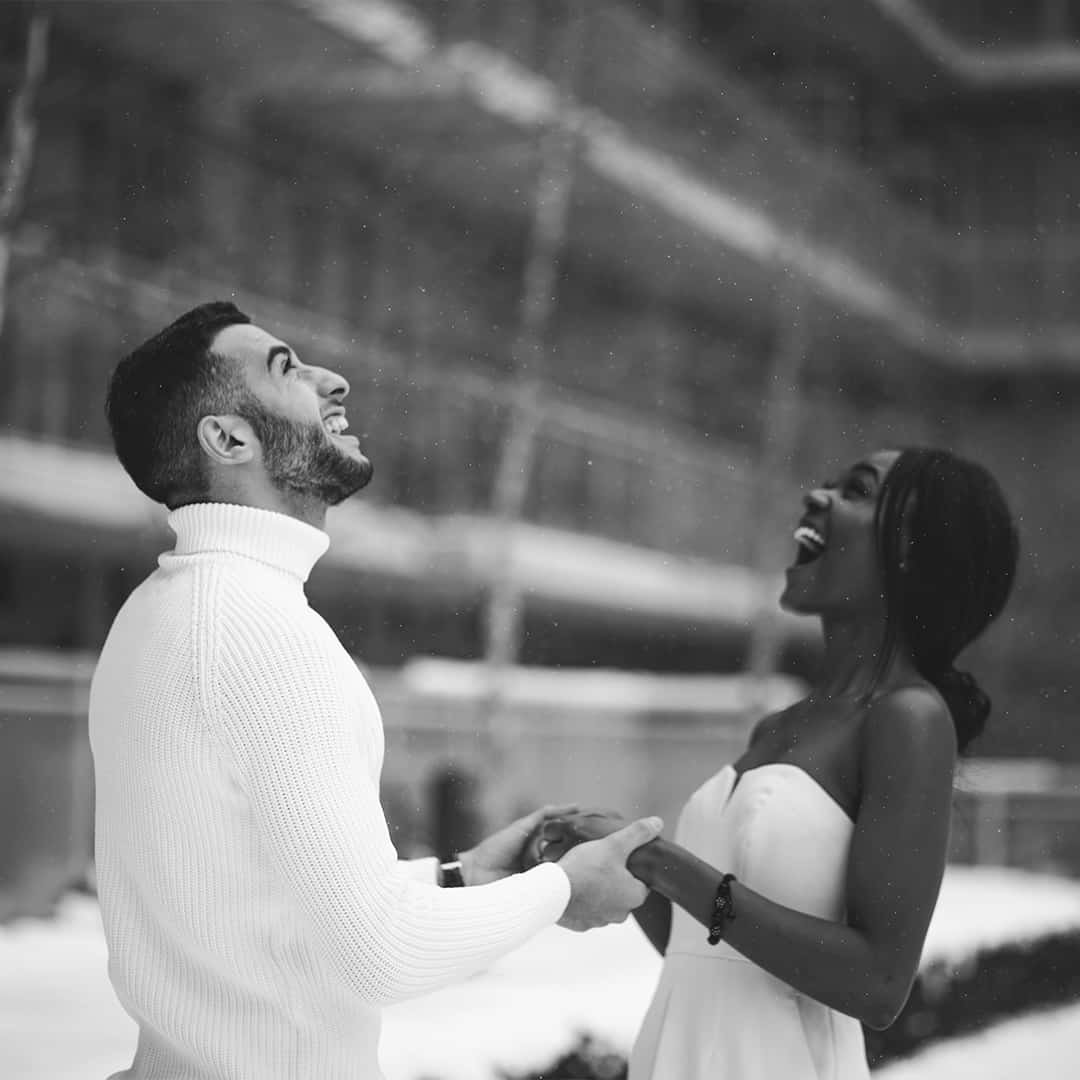


If your partner proposed without an engagement ring, you may be feeling several things at once: excitement, joy, surprise, and maybe a little uncertainty about what comes next. Here is the part that matters most. You said yes to someone you love, and no piece of jewelry changes that.
You are also in good company. The Knot 2024 Jewelry and Engagement Study, which surveyed more than 7,000 recently engaged couples, found that 77% of those proposed to had some involvement in selecting or purchasing their ring, and 29% shopped alongside their partner. Choosing a ring together has quietly become one of the most common ways it happens.
Why Proposals Without Rings Are More Common Than You Think
Modern engagements often look different from the old script, and the reasoning behind a ring-free proposal is usually practical rather than emotional. These are the ones we hear most often.
- Personal taste: Your partner knows you have your own style and wants you to have a ring you will actually love wearing.
- Spontaneous timing: Sometimes the moment is simply too perfect to wait, and the question cannot hold until a ring is ready.
- A partnership mindset: Marriage is a shared decision, and choosing the ring together makes a meaningful first one.
- Budgeting together: Some couples prefer to plan the purchase as a team so you both feel comfortable with it.
- A custom vision: Designing something unique, or setting a family stone, is easier to explore side by side.
Having the Conversation
01
SURPRISE OR TOGETHER
Decide early whether you want to choose the ring as a pair or hand the final call back to your partner. Both work. What causes friction is one of you assuming the other has already agreed to it.
02
AGREE ON A BUDGET
Have the number conversation before you walk into a showroom rather than in front of a case. It is a short conversation when it happens early and an awkward one when it happens late.
03
SET A ROUGH TIMELINE
A complete ring can come home the day you find it. A custom design or a separately chosen loose stone needs bench time. Knowing which you are aiming for tells you when to start.
Couples Who Loved Their Ring-Free Proposals
We hear wonderful stories about proposals that had no ring at all. One partner popped the question with a loop of copper piping left over from a home renovation, decorated so it would not mark her finger. The couple chose a ring together afterward, and that copper band became a keepsake neither of them would trade.
The proposal is the memory. The ring is the thing you wear afterward, and it is allowed to be a separate decision. Over the years we have noticed that the couples who enjoy this most are the ones who stop treating the gap between the two as a problem to solve quickly, and start treating it as the first thing they get to plan together.
Understanding Your Feelings
Mixed emotions are completely normal, and naming what you feel makes it easier to move forward. If a little disappointment is mixed in with the joy, it usually traces back to one of these.
- Missing the surprise: You can still have one. Many couples plan a re-proposal once the ring is chosen.
- What others expect: People often ask to see a ring the moment they hear the news. “We are choosing it together” is a complete answer.
- Wondering what it means: If you find yourself questioning your partner’s certainty, say so directly. It is almost always logistics rather than doubt.
- Feeling officially engaged: An engagement is defined by a shared commitment to marry, not by jewelry. You are engaged from the moment you both say so.
Making Ring Shopping a Memorable Experience
Rather than treating this as an errand, turn it into an occasion you will both remember. Begin with brunch or coffee somewhere meaningful, take photos as you try rings on, plan a toast for afterward, and bring a friend if you would like company. Make a weekend of it if your favorite showroom is a drive away.
A little practical planning protects the mood. Give yourselves longer than you think you need, because trying rings on is the part that changes minds and it cannot be rushed. Come with clean hands and, if you can, without a manicure you are precious about. When you visit us, our VIP diamond viewing rooms give the two of you space to compare stones under proper lighting, at your own pace, and you can book an appointment so that time is set aside.
Exploring Styles Together
The setting is the personality of the ring, the framework that holds the center stone and shapes the whole look. Browsing settings together is one of the best ways to learn what you are drawn to, and people are often surprised by the gap between what they saved online and what they love on their hand. Our guide to settings versus complete rings covers how each route works.
- Classic solitaire: a single center diamond on a clean band, letting the stone take center stage.
- Halo: smaller diamonds encircle the center stone for extra brilliance and a larger overall look.
- Three stone: a center diamond flanked by side stones, often read as past, present, and future.
- Vintage: intricate detail such as milgrain, filigree, and engraving inspired by earlier eras.
- Hidden halo: a ring of small diamonds tucked beneath the center stone, visible only from the side.
- Side stone: additional diamonds along the band add sparkle and dimension.
The rings below are a good first flight to try on, because they differ on everything at once: metal, style, and whether the center stone comes with the ring or is chosen separately.

Luna 14k Yellow Gold Engagement Ring Setting
- 14k yellow gold, Luna
- A setting only, so you choose the center diamond separately
- Built for a round center stone

Poem 14k Rose and 14k White Gold Natural Diamond Engagement Ring 1 ct. tw.
- 14k rose and white gold, Poem
- Two-tone, so it reads differently depending on the angle
- Round natural diamond center, 1 ct. tw.

Eternalle Platinum Lab-Grown Diamond Engagement Ring 3 ct. tw.
- Platinum, dense and naturally white
- Princess cut lab-grown center stone
- 3 ct. tw., a complete ring rather than a setting
Diamond Shapes to Consider
The shape of the center stone changes the entire feel of the ring, so it is worth trying a few on your hand before deciding.
- Round brilliant: the most popular shape, with exceptional sparkle and easy versatility.
- Oval: elongated and elegant, often appearing larger than a round of equal weight.
- Cushion: soft rounded corners for a romantic, vintage feel.
- Emerald: a step-cut rectangle with sleek, mirror-like facets.
- Pear: a teardrop silhouette that blends round and marquise.
- Marquise: elongated with pointed ends, maximizing the look of carat weight.
- Radiant: a rectangle with trimmed corners and brilliant faceting.
- Princess: a square shape with brilliant faceting, modern and eye-catching.
Reading about shapes only gets you so far. Here is how some of them actually sit, from an elongated oval to a pointed pear to a step cut that trades sparkle for clean lines.

Poem 14k Yellow Gold Natural Diamond Engagement Ring 1 ct. tw.
- Oval center stone, the shape that reads longest on the finger
- Halo of round diamonds above a pave shank
- 1 ct. tw. in 14k yellow gold, natural diamonds

Poem 14k White Gold Natural Diamond Engagement Ring 1 1/3 ct. tw.
- Pear shaped center stone, round at one end and pointed at the other
- Halo above a braided pave shank
- 1 1/3 ct. tw. in 14k white gold, natural diamonds

14k Yellow Gold and 14k White Gold Solitaire Engagement Ring Natural Emerald Cut Diamond Center 5/8 ct. tw.
- Emerald cut center stone, step cut rather than brilliant
- A plain polished band with nothing beside the stone
- 5/8 ct. tw., white gold head on a yellow gold band
Choosing Your Metal
Metal shapes the look and the wear alike, and our complete guide to wedding band metal options compares them on weight, engraving and resizing. White gold is a bright, silvery classic; yellow gold is warm and traditional; rose gold brings a romantic pink hue; platinum is dense and naturally white; and two-tone combines two of them.
A helpful trick: look at the jewelry you already reach for, since your everyday pieces quietly reveal the tones you gravitate toward. It is also worth seeing the same kind of ring in different metals side by side, because the metal changes how warm the diamond looks as much as it changes the band.

Henri Daussi 14k Rose Gold Natural Diamond Engagement Ring 1 ct. tw.
- 14k rose gold, Henri Daussi
- Cushion cut center inside a halo, on split shoulders
- 1 ct. tw., natural diamonds

Eternalle Platinum Lab-Grown Diamond Engagement Ring 4 1/4 ct. tw.
- Platinum, dense and naturally white
- Oval center on a slim pave shank, nothing else competing
- 4 1/4 ct. tw., lab-grown

Eternalle 14k Yellow Gold Lab-Grown Diamond Engagement Ring 2 1/2 ct. tw.
- 14k yellow gold, Eternalle
- Oval center with a scrolling vine shank set with diamonds
- 2 1/2 ct. tw., lab-grown
Lab-Grown or Natural
Lab-grown and natural diamonds are chemically and optically identical, so the choice comes down to origin and what matters to you. Our lab-grown diamond guide goes further into how they are made and graded. Some couples are drawn to the rarity and heritage of a natural stone. Others love that lab-grown often means a larger diamond within the same budget. We carry both and will not tell you which to want.
What the choice does not change is how the ring is looked after. Both kinds of stone are graded the same way, set by the same bench, and covered by the same warranty once the ring is yours, so this is a decision about what the stone means to you rather than about what you will live with afterward.
Announcing Your Engagement and What Comes After
Share the news whenever it feels right, before or after you have a ring. If you would like something on your finger in the meantime, a simple placeholder band or a fun temporary ring is a good stand-in while you shop, and plenty of people keep theirs afterward as a memento of this stretch.
Once you have found or designed the one, there are a few ways to close the loop. Have your partner slip the finished ring on in a moment of its own, or plan a full re-proposal somewhere meaningful. Past the engagement ring, our guide to choosing your wedding jewelry picks up. Add jewelry insurance so the ring is protected from the day you take it home, and ask us how to care for it so it keeps its sparkle.
The Robbins Brothers Difference
Walking into a showroom should feel welcoming, never pressured. Our consultants guide and educate rather than push, and you can try on as many rings as you like to see how different shapes, settings, and metals actually sit on your hand. Walk-ins are welcome, and booking ahead guarantees dedicated time.
We have been part of this moment for couples since 1921, and we are employee owned. Our master jeweler works in house, so a custom design or a reset family stone happens under our roof. When you are ready to think about bands, we carry both women’s and men’s wedding rings, and you are welcome at any of our showrooms across California, Arizona, Texas, and Washington.
Frequently Asked Questions
Are we really engaged without a ring?
Yes. An engagement is a mutual promise to marry, and it takes effect the moment you both agree to it. The ring is a symbol of that promise, not the thing that creates it. Plenty of couples are engaged for weeks or months before a ring is chosen.
How soon should we start shopping for the ring?
Whenever you are both ready. The practical thing to know is that engagement season runs from late November through February, so showrooms are at their busiest exactly when most newly engaged couples start looking. Booking ahead matters more in those months than at any other point in the year.
Can we still have a surprise if we shop together?
Absolutely, and many couples do exactly this. Shop together to narrow it down to the ones you love, then let your partner make the final call and re-propose with it. You get the input and the surprise, which is the best of both.
What do we tell people who ask to see the ring?
“We are choosing it together” is a complete answer and usually gets a warm response, because it is increasingly what people expect. You do not owe anyone an explanation for how your engagement is unfolding.
Should we buy a complete ring or a setting and diamond separately?
A complete ring is faster and simpler, since the pairing is already done. Choosing separately gives you control over the exact stone and usually more say in the final look, at the cost of a longer timeline and two decisions instead of one. Both routes are represented among the rings on this page.
Does the metal change how the diamond looks?
It does, more than most people expect. A warm yellow or rose gold setting can make a faintly tinted stone read warmer, while white gold and platinum keep it looking cooler. This is one of the clearest arguments for trying the same shape in more than one metal before you decide.
Do we need to know a ring size before visiting?
No. Since you are shopping together, we can size you in person, which is more accurate than guessing anyway. That is one clear advantage of choosing the ring after the proposal rather than before.
Can a family diamond be used in a new ring?
Yes, and it is one of our favorite projects. Our master jeweler can reset an inherited stone into a new setting or design something around it. Bring it in and we will look at the stone first, since its shape and proportions determine which settings will hold it well.
Do we need an appointment to shop together?
Walk-ins are always welcome. Booking ahead simply means a consultant is ready when you arrive and can have options pulled, which is worth doing if you are coming as a pair and want unhurried time in a viewing room.
Or find a Robbins Brothers near you and start the next part together. You can also browse our Pinterest board for inspiration.
Recommended
Summer’s Most Romantic Spots in Inland Empire and San Diego
If you’re in love…be sure to visit one of these romantic locations with your sweetie. All serve as the perfect…
read more
Find Out Your Engagement Ring Style
You have decided to shop for an engagement ring. Congratulations. Then you open the first case and there are two…
read more
Best Places In Arizona To Find Your Dream Wedding Dress
By guest blogger Rochelle York, personal stylist After a proposal the first thing that comes to any bride’s mind is…
read more