Home » Engagement & Wedding Rings » Engagement Rings
Pear-Shaped Diamond Engagement Rings with Wedding Bands
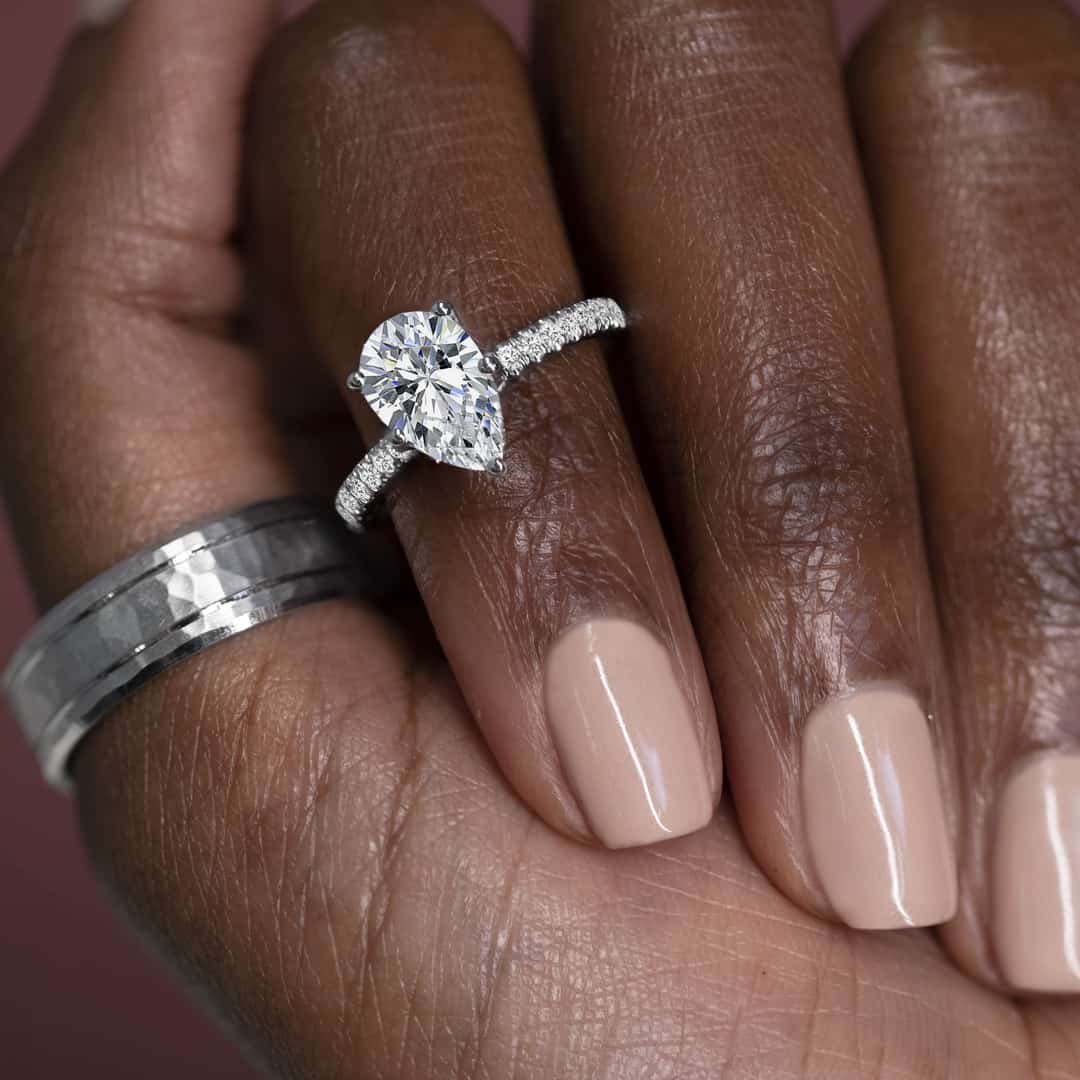


A pear-shaped diamond joins the rounded end of an oval to the single point of a marquise, which is why it is often called a teardrop. The shape carries brilliant faceting along an elongated outline, so it sparkles like a round while flattering the finger like a marquise.
This guide covers what makes the cut distinctive, the settings that suit it, and the bands that sit against it, which is the question a pointed shape raises and a rounded one does not.
What Makes the Pear Cut Special
01
BRILLIANT SPARKLE
Brilliant faceting through a long outline, so the stone throws light the way a round does rather than in the broad flashes of a step cut.
02
ELONGATED SILHOUETTE
The length draws the eye down the finger, and the shape tends to read larger than a round of the same weight.
03
VERSATILE STYLING
It takes a solitaire, a halo, or a mixed-metal setting equally well, and the point gives the ring a clear direction on the hand.
There are two routes into a pear. You can start with a setting made for a pear-shaped diamond and choose the exact center diamond yourself, or take a complete ring where the pear-shaped center is included. The group here shows the shape in white metal along both routes.
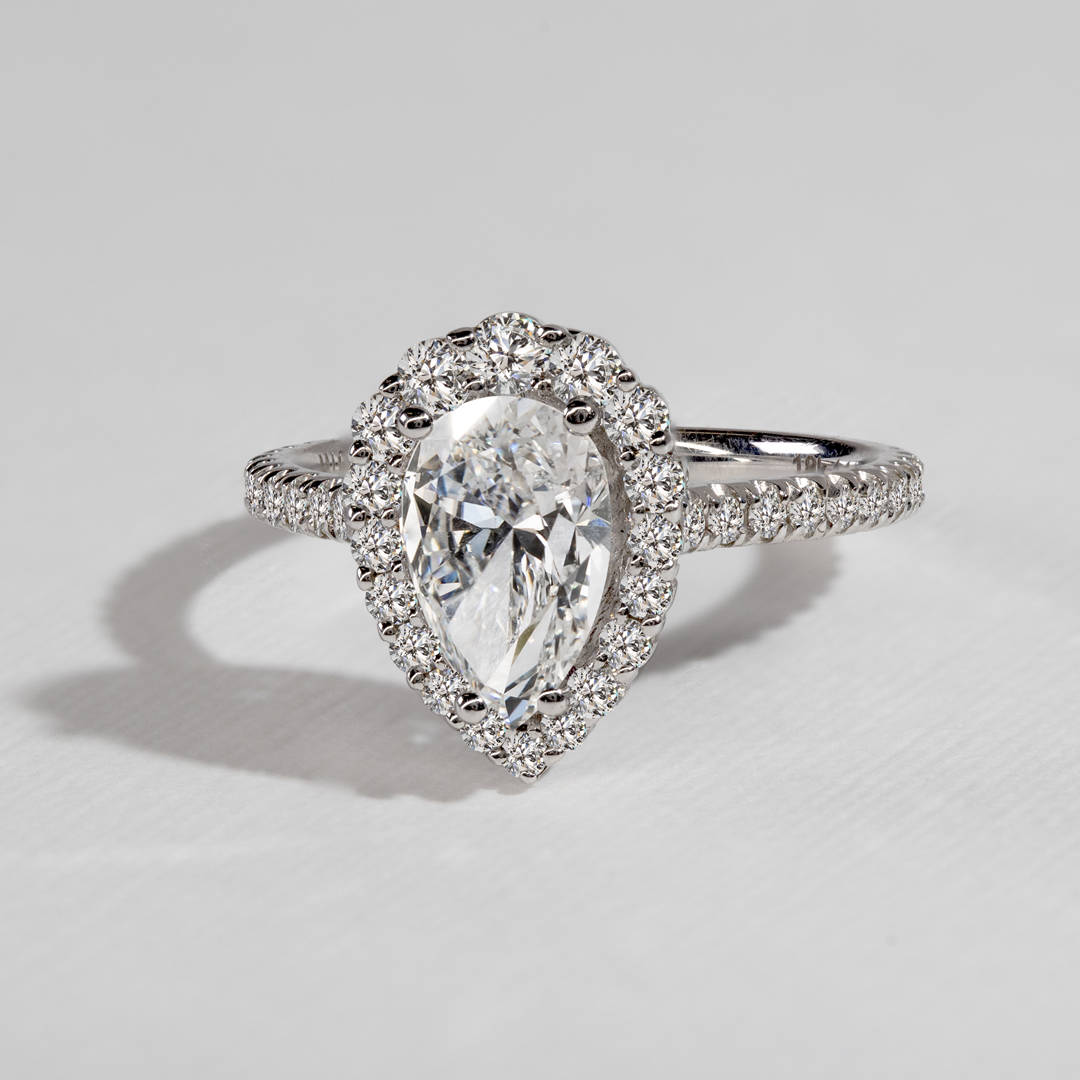
Michael M. 18K White Gold Natural Diamond Engagement Ring Setting
- 18K white gold from Michael M., 1/2 ct. tw.
- Shaped to hold a pear, center stone sold separately
- Designer collection setting

Poem 14K White Gold Natural Diamond Engagement Ring
- 14K white gold from Poem
- Complete ring with a pear-shaped center diamond
- 3/4 ct. tw.

Poem 14K White Gold Natural Diamond Engagement Ring
- 14K white gold from Poem
- Complete ring with a pear-shaped center diamond
- 1 1/3 ct. tw.
Pear-Shaped Engagement Ring Styles
A pear suits more settings than most shapes, and the metal around it changes its character more than the setting style does. Warm metal softens the point; white metal sharpens it. A plain solitaire lets the outline carry the ring, while our lab-grown diamond engagement rings make the longer end of the size range easier to reach. Designer work from Tacori, Verragio and Michael M. is worth seeing side by side, since each treats the point differently.

Poem 14K Yellow Gold Natural Diamond Engagement Ring
- 14K yellow gold from Poem
- Complete ring with a pear-shaped center diamond
- 1 1/3 ct. tw.
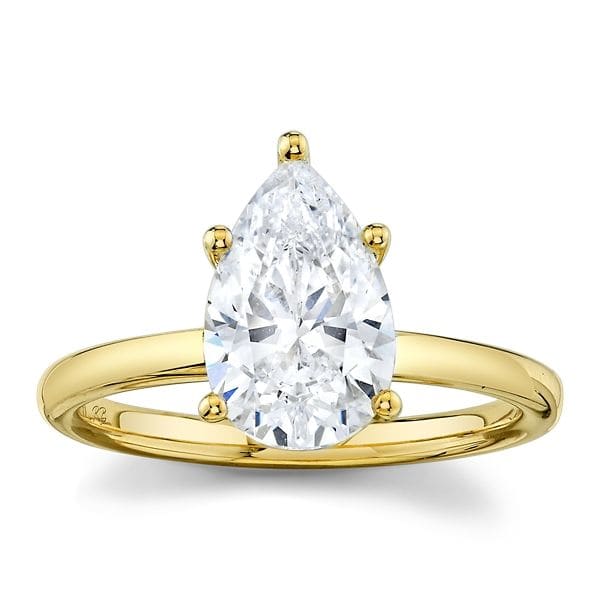
Suns and Roses 14K Yellow Gold Natural Diamond Engagement Ring Setting
- 14K yellow gold from Suns and Roses
- Shaped to hold a pear, center stone sold separately
- .06 ct. tw. of accent diamonds

Eternalle 14K White Gold Lab-Grown Diamond Engagement Ring
- 14K white gold from Eternalle, lab-grown diamonds
- Complete ring with a pear-shaped center diamond
- 2 1/2 ct. tw.
Pear-Shaped Diamond Engagement Rings with Halo Settings
Halo settings wrapped around a pear trace the teardrop outline and make the center read larger. A halo also puts metal and small stones around the point, which adds a measure of protection to the most vulnerable part of the diamond. If you like the effect pushed further, floral or vintage patterns build on the same idea.

Cherish 14K White Gold Natural Diamond Engagement Ring
- 14K white gold from Cherish
- Diamond halo framing the pear-shaped center
- Complete ring, 3/4 ct. tw.
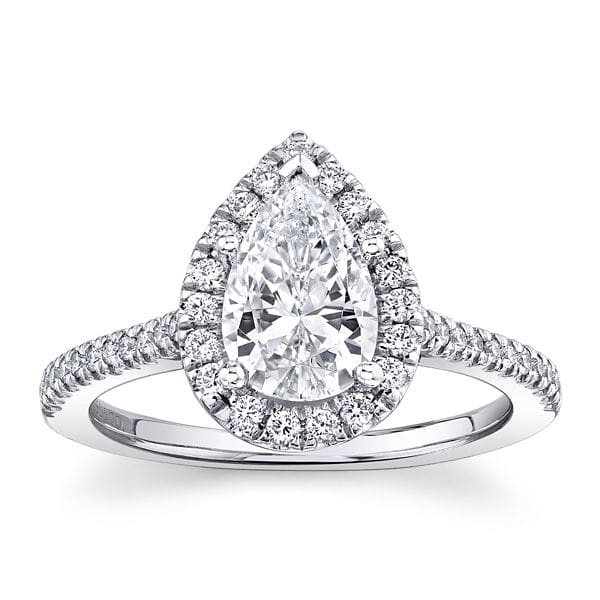
Gabriel & Co. 14K White Gold Natural Diamond Engagement Ring Setting
- 14K white gold from Gabriel & Co.
- Shaped to hold a pear, center stone sold separately
- 1/3 ct. tw. of accent diamonds
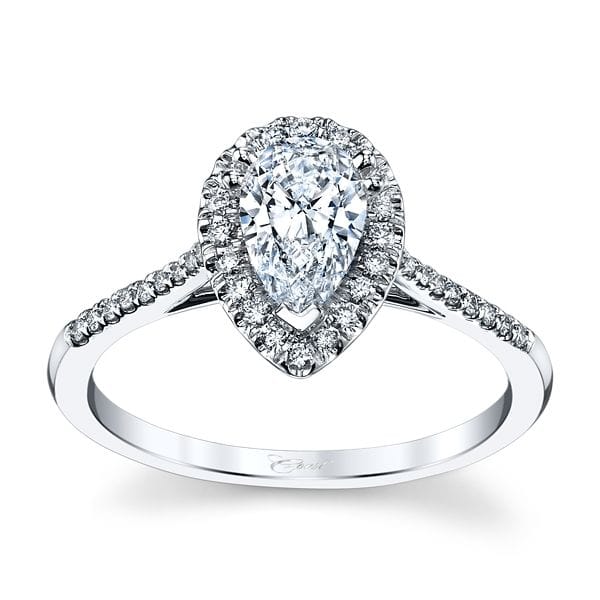
Coast 14K White Gold Natural Diamond Engagement Ring Setting
- 14K white gold from Coast
- Shaped to hold a pear, center stone sold separately
- 1/6 ct. tw. of accent diamonds
Pear-Shaped Diamonds in Rose Gold and Two-Tone Settings
A rose gold engagement ring gives a pear a softer, more romantic reading, and a two-tone mounting lets the shank pick up one metal while the head holds another.
That combination can make a white center stone look brighter than it does in white metal alone, because the warm shank gives the eye something to measure it against.
Warm metal also softens the point, which some people want and others specifically do not.

Verragio 18K White and 20K Rose Gold Natural Diamond Engagement Ring Setting
- 18K white gold and 20K rose gold from Verragio
- Shaped to hold a pear, center stone sold separately
- 1/2 ct. tw. of accent diamonds

Verragio 14K White Gold and 14K Rose Gold Natural Diamond Engagement Ring Setting
- 14K white gold and 14K rose gold from Verragio
- Shaped to hold a pear, center stone sold separately
- 1/3 ct. tw. of accent diamonds

Tacori 18K Rose Gold Natural Diamond Engagement Ring Setting
- 18K rose gold from Tacori
- Shaped to hold a pear, center stone sold separately
- 1/2 ct. tw. of accent diamonds
Wedding Bands to Pair With Your Pear-Shaped Engagement Ring
This is where a pear differs from a rounded shape. The point sits low and forward, so a straight band will often leave a small gap beside it. Whether that matters is personal, and it is much easier to judge with the pair on your hand than from a description.
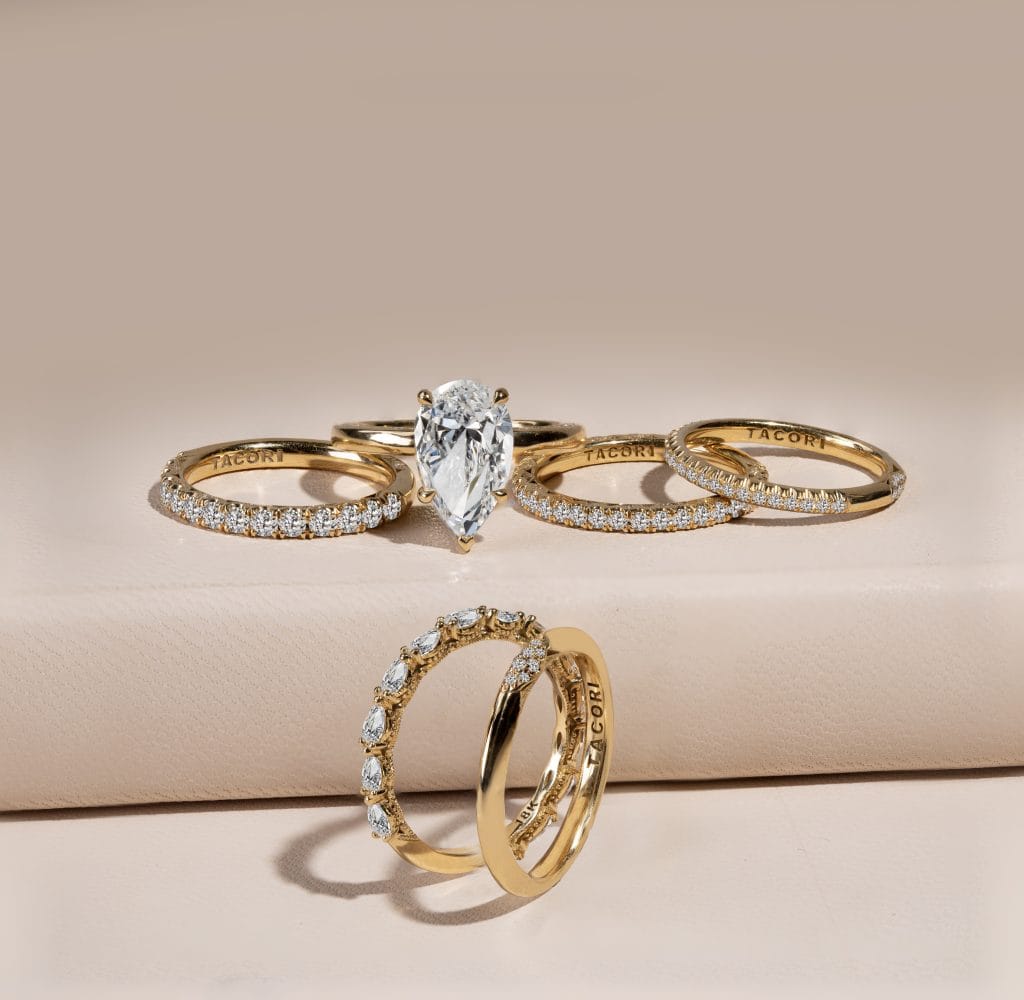
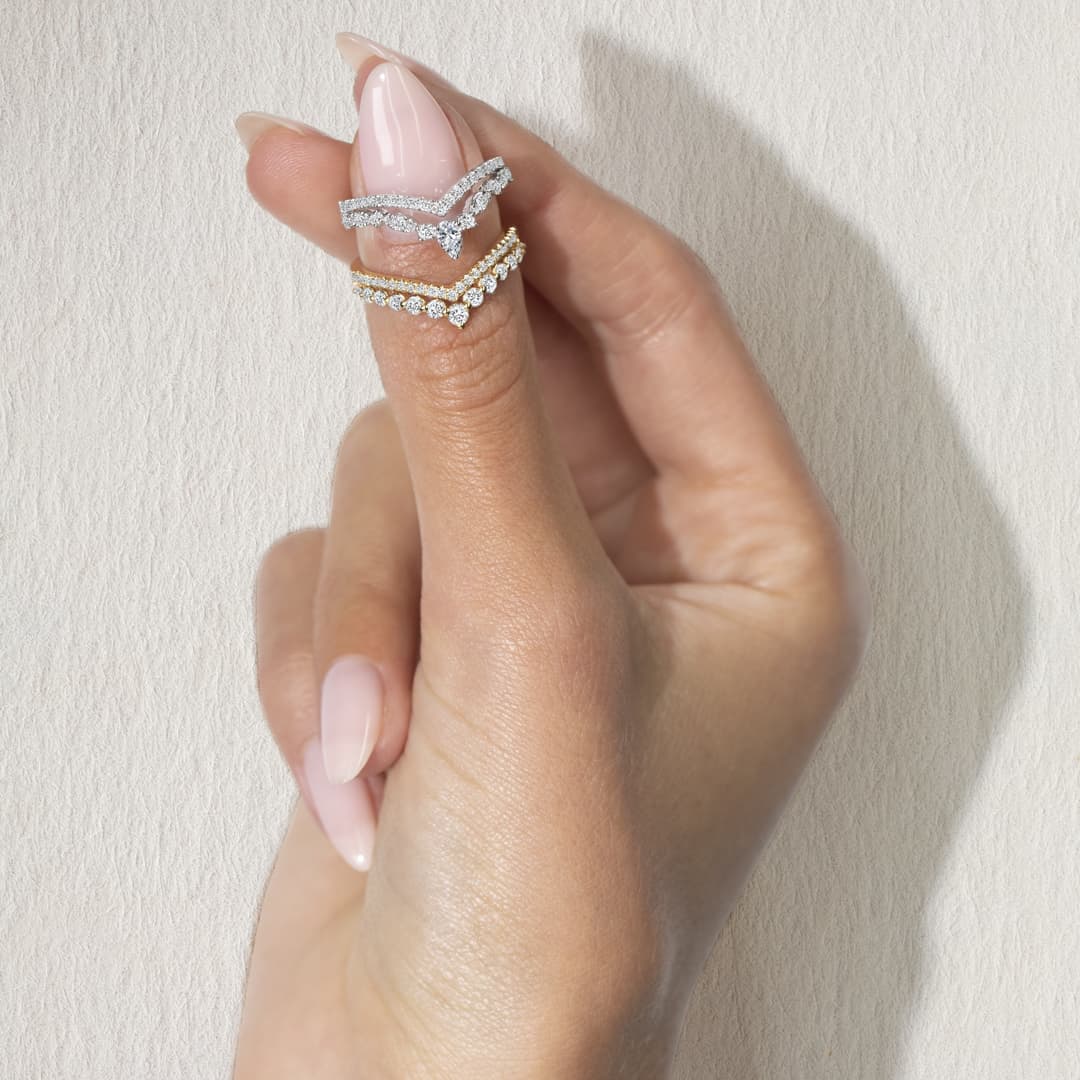
A chevron wedding band answers the gap a different way. It comes to a point rather than a curve, so the V tucks under the tip of the pear instead of running flat across it. The same idea works in any metal, and ring wraps and enhancers are another route if you want to frame a ring you already own.

14K White Gold Natural Diamond Wedding Band
- 14K white gold, natural diamonds
- Chevron silhouette that points under a pear-shaped center
- 1/5 ct. tw.

14K Yellow Gold Natural Diamond Wedding Band
- 14K yellow gold, 1.6 mm shank, polished
- Gently curved chevron that warms a yellow gold or two-tone ring
- 1/6 ct. tw.

14K Rose Gold Natural Diamond Wedding Band
- 14K rose gold, natural diamonds
- Chevron set with a pear-shaped stone at the point
- 1/4 ct. tw.
A contour band solves the same problem with a curve instead of an angle, following the outline of the pear so the engagement ring and the band read as one continuous line rather than two shapes meeting at a point.
Caring for a Pear-Shaped Diamond Ring
The point is the part to watch. A V-shaped prong protects it, but any prong can loosen over time, and on an elongated stone a loose prong shows up as movement before it shows up as damage. Warm water, mild soap and a soft brush keep it bright between visits, our lifetime cleaning and inspection covers the rest, and a product protection plan covers what ordinary wear does not.
The Robbins Brothers Difference
A pear asks two questions a photograph cannot answer: how the bow-tie behaves as the ring moves, and how a band sits against the point. Both are answered in about a minute with the rings on your hand. We keep a range on hand precisely so that comparison is possible, and our diamond experts will point out what they are seeing rather than leave you to guess.
Frequently Asked Questions
Frequently Asked Questions
What is a pear-shaped diamond?
A pear combines the rounded end of an oval with the single point of a marquise, which is why it is sometimes called a teardrop. That asymmetry is the whole appeal: it reads elegant from every angle and elongates the finger. Visit a showroom to see how one sits on your hand.
Which way should a pear-shaped ring point?
Most guests wear the point facing away from the body, toward the fingernail, because that direction lengthens the finger most. There is no rule, and some people prefer it the other way. It is worth trying both before deciding, since the ring will sit that way for a long time.
Does a pear-shaped diamond look bigger for its carat weight?
Often, because it spreads its weight across a long face rather than down into the depth. Ask for the millimeter measurements alongside the carat weight; that is the pair of numbers that tells you what will actually show.
How do I protect the point of a pear-shaped diamond?
The tip is the thinnest part of the stone and the part most likely to chip. A V-shaped prong cups it and takes the knock before the diamond does. It is the single most important detail in a pear setting.
What is the bow-tie effect?
A shadow that can fall across the middle of an elongated stone where the facets fail to return light. A faint one is normal and invisible in wear; a strong one dulls the center. It moves as the ring moves, so a photograph will not tell you.
What wedding band works with a pear-shaped engagement ring?
A contoured band curved to trace the outline sits flush against the point, while a straight band leaves a small gap that some people like and others do not. Both are valid; it depends whether you want the two rings to read as one piece or as two.
Is a lab-grown pear a good idea?
Both lab-grown and natural stones are real diamonds with the same optical behavior, and on an elongated shape a lab-grown stone often buys noticeable extra length for the same outlay. Our guide to lab-grown vs. natural diamonds covers the trade-offs.
Can I wear a pear-shaped ring every day?
Yes, with the right setting. The point needs protecting and the prongs need checking periodically, which is true of any elongated shape. Our lifetime cleaning and inspection covers exactly that.
Can you create a custom pear-shaped engagement ring?
Our master jeweler can build a ring, or a band to sit against one, around a pear you choose. Bring your ideas to an appointment and we will work them into a design.
For more inspiration:
- Our pear-shaped engagement ring Pinterest board
- Halo engagement ring settings
- Rose gold engagement rings
Ready to see a pear in person? Find a Robbins Brothers near you and let our experts help you find the one. You can also browse our Pinterest board for inspiration.
Recommended
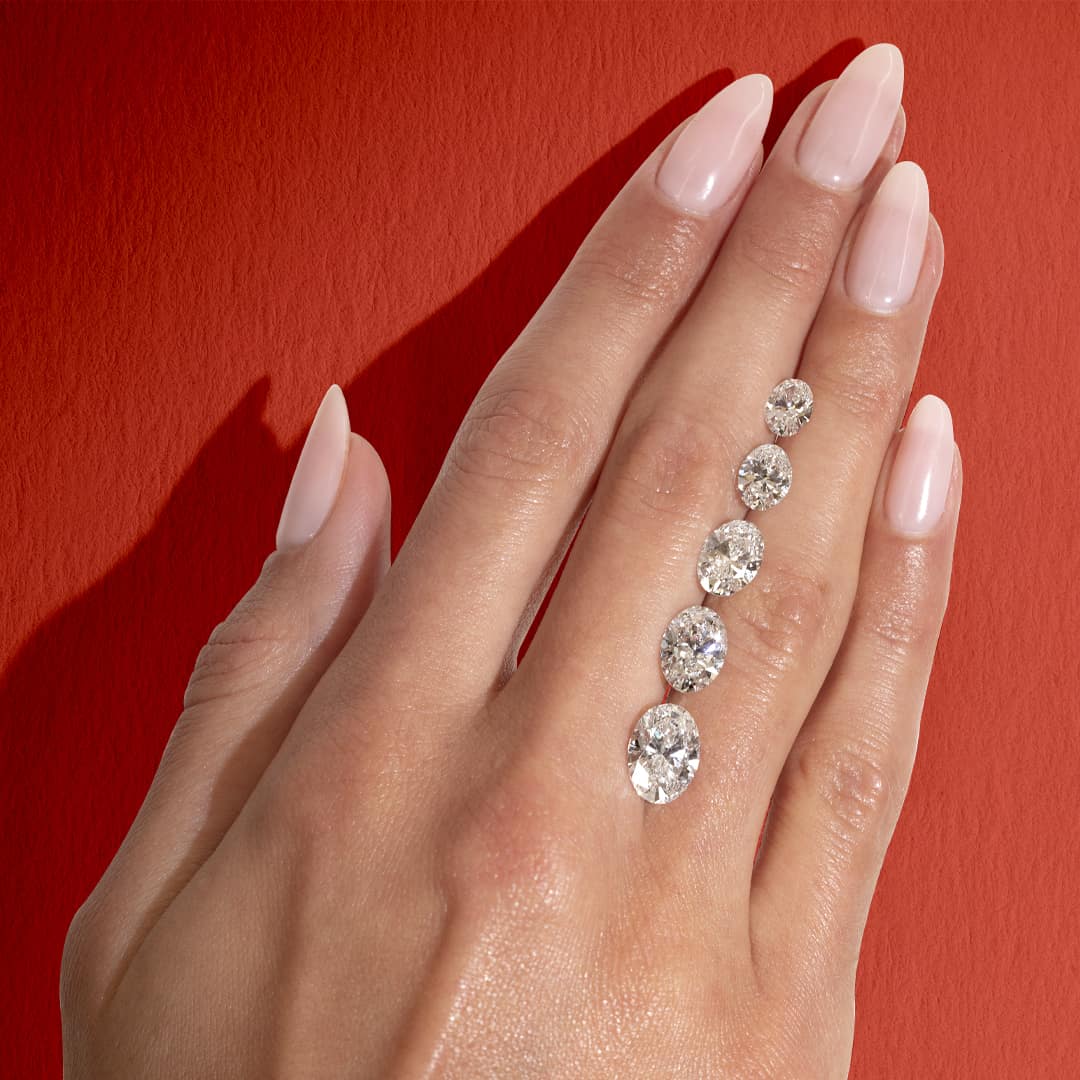
All About Oval Diamond Engagement Rings
Oval diamond engagement rings pair the fire of a round brilliant with a longer, softer outline, and the shape has…
read more
Embracing the Modern: A Guide to Contemporary Engagement Rings and Wedding Bands
Modern engagement rings and wedding bands weave tradition with
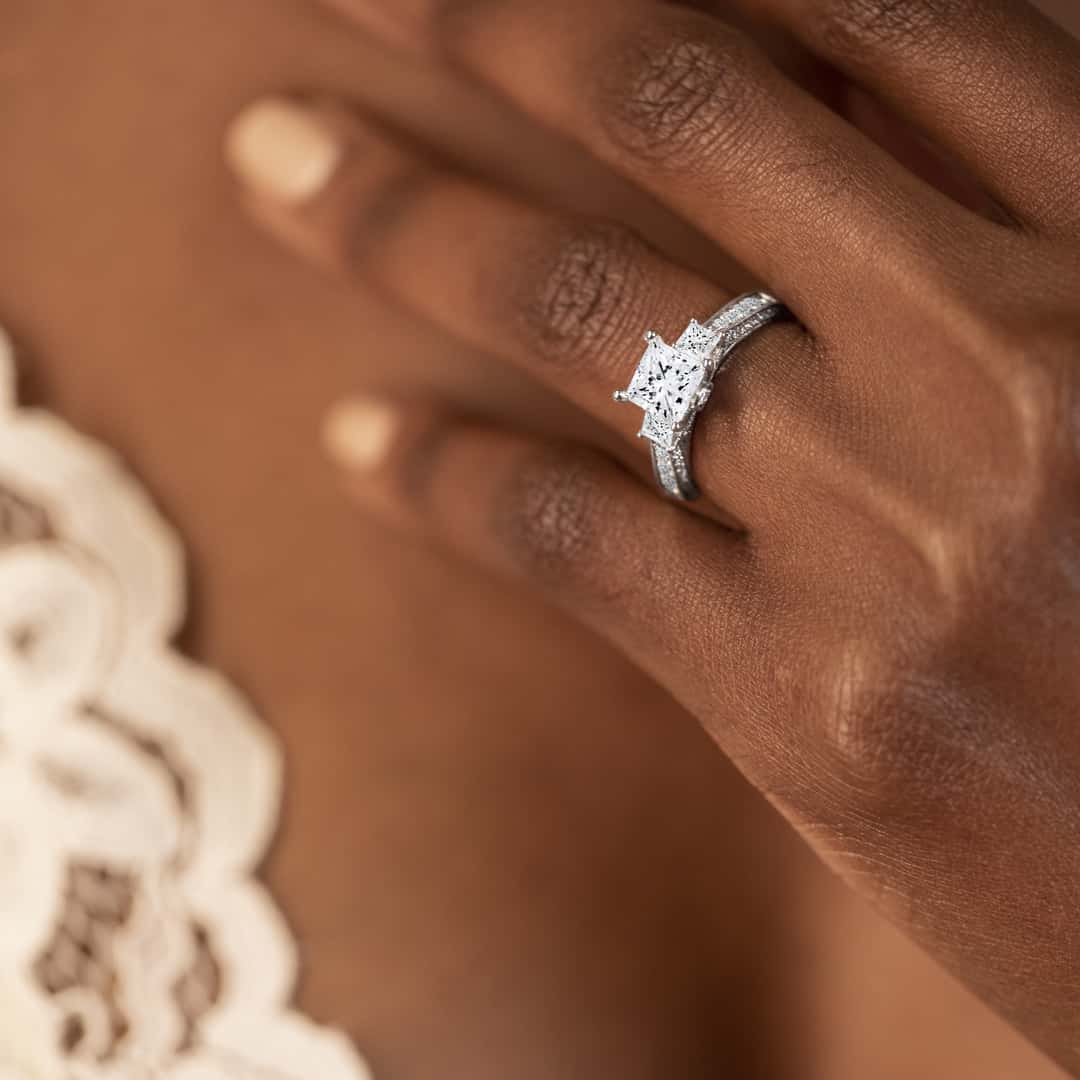
All About Princess Cut Diamonds for Engagement Rings
A princess cut is a square diamond with sharp corners and a brilliant facet structure, essentially the fire of a…
read more