Home » Engagement & Wedding Rings
What’s an Old Mine Elongated Cushion Cut Diamond and a Bezel Engagement Ring Setting? All the Details about Taylor Swift’s Fantastic Engagement Ring
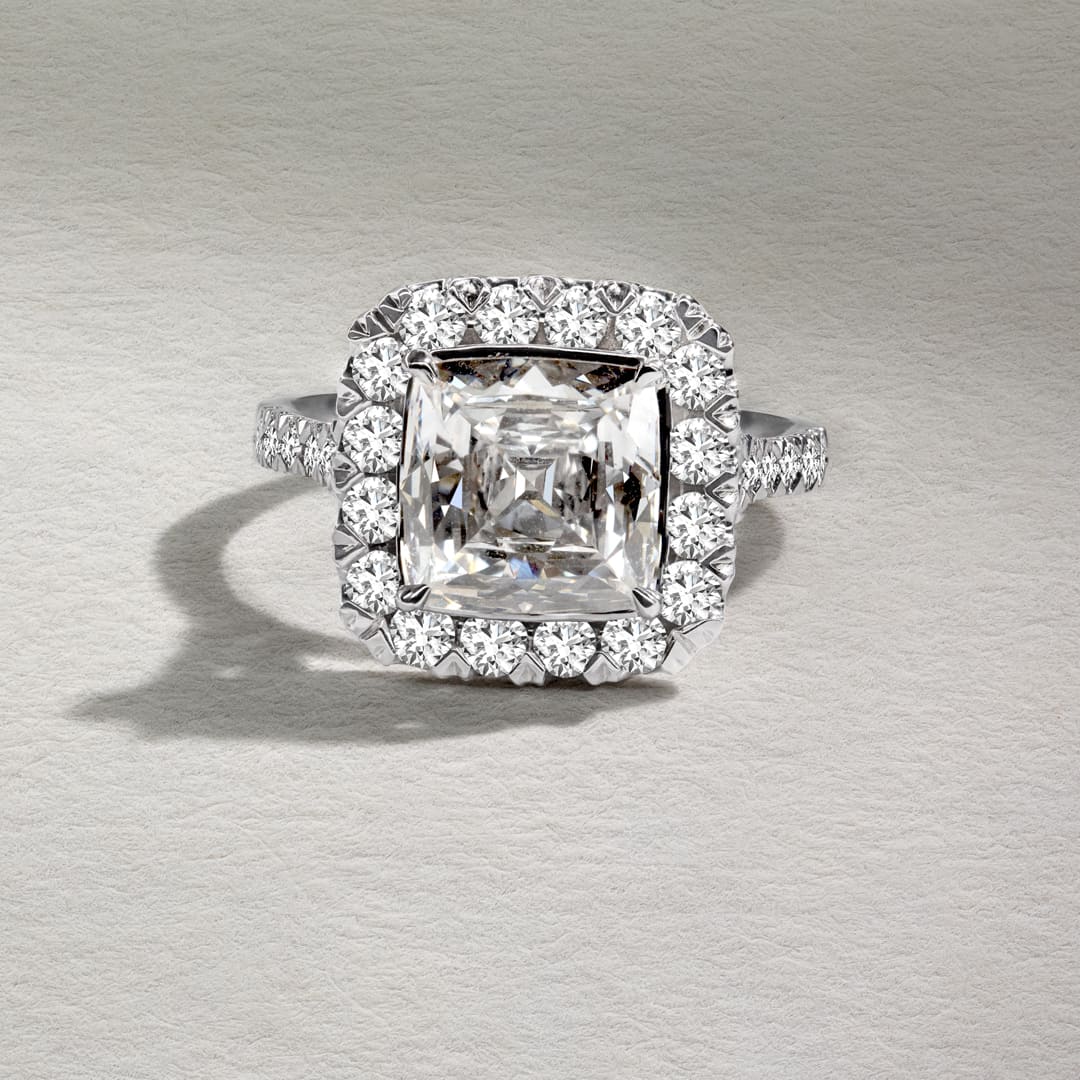


We’ve all seen the proposal and the ring (and the fan edits and the podcast and the…). But exactly what kind of ring did Travis design for Taylor? And can you incorporate some of those elements in your own engagement ring? We’re here to walk you through it all and show you how you can get your own beautiful version without Travis’s budget.
Taylor’s ring is an old mine elongated cushion cut diamond in a hand-engraved yellow gold bezel (or bezel look) setting with four prongs and small sidestones. The diamond is reportedly a G color grade with VVS or IF clarity. That’s an amazing ring with some advanced details so let’s start with diamond basics and work our way up to expert level.
What is a cushion cut diamond?
The key feature of a cushion cut diamond is its square or rectangular shape with rounded corners. A cushion cut diamond is square (1 – 1.05 length to width ratio) or slightly rectangular (1.1 – 1.2 length to width ratio) and an elongated cushion cut diamond is rectangular (with a length to width ratio over 1.2).
A cushion cut diamond differs from other cuts in a number of ways:
- Princess cut – has angular corners and is generally a square shape
- Radiant cut – has clipped corners rather than rounded; can be square, rectangular, or elongated rectangular
- Emerald cut – can look similar to an elongated cushion cut but is more geometric with square corners
- Oval – a very elongated cushion cut diamond can resemble an oval (which has no corners)


Below are examples of the square cushion cut with similar diamond shapes for comparison:
 |  |  |
 |  |  |
 |  |  |
| 1.0017 ratio | 1.025 ratio | 1.0 ratio |
What is an elongated cushion cut diamond?
An elongated cushion cut diamond is rectangular cushion cut and typically falls into the “elongated” range once it has a length to width ratio of over 1.2. (Once the ratio is over 1.3, the diamond can resemble an oval or radiant cut.) Below are comparisons of an elongated cushion cut diamond vs. an oval and elongated radiant cut.
 |  |  |
 |  |  |
 |  |  |
| 1.2 ratio | 1.3 ratio | 1.22 ratio |
 |  |  |
 |  |  |
 |  |  |
| 1.37 ratio | 1.65 ratio | 1.38 ratio |
What is an old mine diamond?
True old mine cut diamonds were hand-cut before the advent of modern cutting technology (and are often more than a hundred years old), which means that all true old mine cut diamonds are natural diamonds and are antiques. They have larger, sometimes uneven facets (contributing to their uniqueness as no two are alike) vs. modern cut diamonds.
Because of these features, they reflect candlelight well and also tend to reflect colors. (Some noted that Taylor’s ring seemed to have a green tint, which is because the larger facets were reflecting her garden surroundings).
What is VVS and IF clarity?
The clarity of a diamond refers to the tiny marks or inclusions in the diamond. The more flawless a diamond, the rarer and generally more expensive it is. In the case of Taylor’s diamond, since it’s an old mine cut, it has larger facets and inclusions can be more noticeable. IF (internally flawless) clarity diamonds are nearly perfect and have no internal inclusions visible under 10x magnification. IF is only one step below FL (flawless), which is the highest clarity rating a diamond can have. (FL and IF clarity diamonds look the same to the naked eye and differences can only be spotted under magnification.)
VVS1 and VVS2 (very very slightly included) clarity diamonds have inclusions that are extremely difficult to see under 10x and VS1 (very slightly included) clarity diamonds have minor inclusions that are hard to see under 10x magnification. (Learn more about the 4Cs.)
What is a G color grade for a diamond?
The letter color grades indicate the color of the diamond, from colorless (D-F) to light yellow (S-Z). It’s not necessarily the case that a colorless diamond is “better” as the best diamond color grade comes down to preference. Old mine diamonds are less technically “perfect” than diamonds cut with new technology and that makes them more unique. Slight color to a diamond, especially when paired with yellow gold, can result in a ring with a lot of warmth that looks vintage rather than modern.
Some have speculated that Taylor’s diamond is D-F in color but reports are that it is a G color grade, which is the perfect shade for this vintage style ring and ideally complements the yellow gold. If you’d like similar vibes of warmth and coziness, consider pairing a yellow gold setting with a diamond that has a color rating of G or beyond.
What is a bezel setting and what are prongs?
A bezel is a rim of metal that encircles the diamond. This type of setting protects the diamond from chips. While most bezel settings don’t have prongs (claw-like supports that grip the sides of the diamond), Taylor’s ring appears to have both so it’s possible the prongs are securing the ring and the bezel-like style surrounding the diamond isn’t a true bezel.
With a ring setting that has a bezel look (rather than a true bezel setting), the diamond isn’t set in the bezel (prongs secure the diamond to the ring) but a rim of metal surrounds the center diamond (like a metal version of a halo) to give the same appearance as a bezel setting.


What are sidestones?
Sidestones are part of the ring setting and are small diamonds on either side of the center diamond. They can be part of a ring design or engraving, such as seems to be the case with Taylor’s ring.


Getting the look
Taylor’s ring, in addition to everything above, has an antique, vintage feel to it (both because of the old mine diamond and the overall ring setting style) and is hand-engraved. While you might not have the same budget as Travis Kelce, you can still recreate the essence of this ring (while making it your own).
Consider vintage styles in yellow gold: while Taylor’s ring isn’t overly ornate, it does have some engraving detail with small sidestones on each side of the shank (band) and the warmth of the yellow gold gives a romantic old world touch. Below are some examples of vintage-style, yellow gold ring settings.


Choose an elongated cushion cut with minimal ornamentation: an old mine cushion cut may be outside the budget of many of us, but an elongated cushion cut has the same silhouette and a solitaire or setting without a lot of additional diamonds or features keeps the focus on the beautiful center diamond.


Examine loose diamonds with color grades of faint color or very light color: These diamonds often are priced more affordably than colorless and near colorless diamonds and can add warmth and an antique air to the ring.
Consider a bezel look rather than a true bezel setting: crafting a bezel is precise work and is custom made for the diamond dimensions. A bezel look has the same style and look without the extra cost.
Choose 14k yellow gold: Taylor’s ring reportedly is 18k gold. 14k gold can be more affordable and has the additional advantage of being more durable and less prone to scratches. Both are a beautiful, warm gold.
Opt for a wide band: Taylor’s wide band suits the very elongated style of the diamond well and the result is a well balanced ring with no competing elements.


Ensure your ring reflects your personal style: what makes Taylor’s ring so perfect is that it is a true reflection of who she is: romantic, nostalgic, writing with a quill pen and a bottle of ink. Think of the adjectives that best describe you and look for a ring that reflects them.
For more inspiration:
Stop into your local Robbins Brothers today and create the ring that reflects the true and perfect you.
Recommended
How to Add Colored Gemstones To Your Jewelry and Engagement Ring Style
If you are looking for something unique and set apart from the every day, colored gemstones might be perfect. Whether…
read more
Guide to Eternity Wedding & Anniversary Bands
An eternity band is a ring set with gemstones, most often diamonds, running around all or most of its circumference….
read more
Benefits of Men’s Tungsten Carbide Rings and Wedding Bands
If you are looking for a men’s wedding band that is durable, modern, and low maintenance, a tungsten carbide ring…
read more